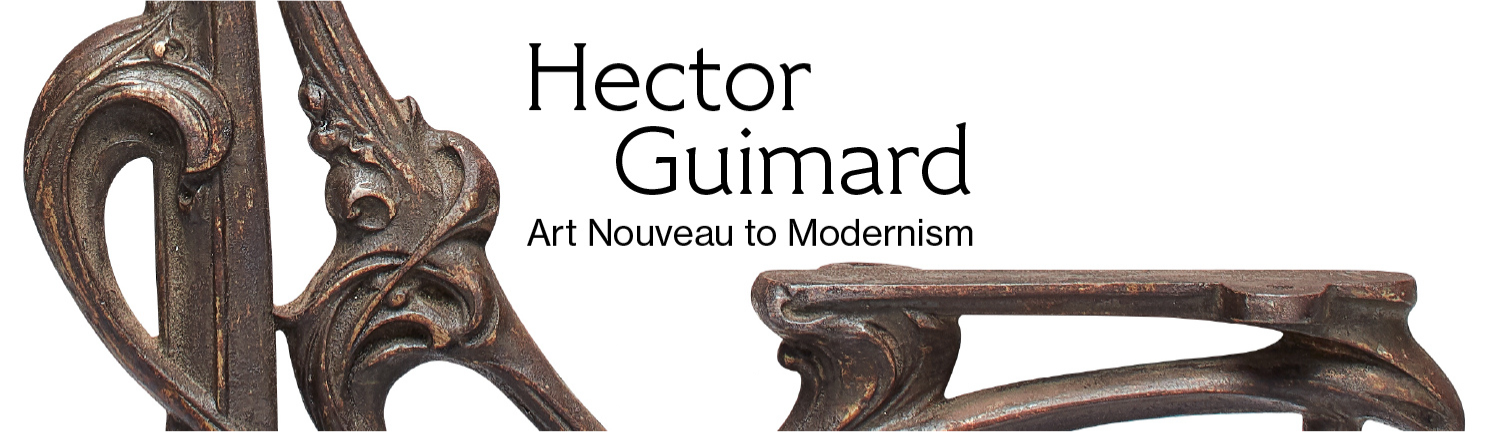
Hector Guimard: Art Nouveau to Modernism explores the life and work of Hector Guimard (1867-1942), the French architect and designer whose name is synonymous with the French Art Nouveau movement. Bringing together approximately 100 works including furniture, jewelry, metalwork, ceramics, drawings, and textiles from collections worldwide, Hector Guimard: Art Nouveau to Modernism is the first major American museum exhibition devoted to Guimard since the retrospective organized by the Museum of Modern Art in 1970.
This exhibition was co-organized with Cooper Hewitt, Smithsonian Design Museum in New York City, where it was on view from November 18, 2022 through May 21, 2023. At the Driehaus Museum, the exhibition was curated by guest curator David A. Hanks, who also edited the accompanying catalogue, and Sarah Coffin, former curator, Cooper Hewitt, Smithsonian Design Museum.
Hector Guimard is best-known for his designs for the Paris Métro, which are so emblematic of the French Art Nouveau style that it was sometimes referred to as “le style Métro.” Representing a radical break from the classical and revival styles of the nineteenth century, Art Nouveau embraced natural forms while integrating architecture with the decorative and fine arts. Hector Guimard: Art Nouveau to Modernism explores Guimard’s commitment to sharing beautiful, sensuous, accessible designs for both civic architecture and everyday objects with a wide audience, as well as Guimard’s modern entrepreneurial approach to promoting his work through Le Style Guimard branding and his use of mass-production technologies. The show also explores the critical role played by his wife and collaborator Adeline Oppenheim Guimard, presenting new scholarship that underscores her critical role as her husband’s creative partner during his lifetime and ardent steward of his legacy.
“This exhibition tells the full story of Guimard’s career, with a new focus on the role his wife played in promoting his work and his innovative efforts to make modern design affordable, accessible, and a force for social good," said curator David Hanks. "The collections of Richard H. Driehaus and the Cooper Hewitt, Smithsonian Design Museum hold some of the most significant objects by Hector Guimard in the United States. We are thrilled to unite these objects alongside important loans from national and international collections, including the Metropolitan Museum of Art, the Museum of Modern Art, and the Musée d’Orsay, to reveal new insights into this remarkable designer and his lasting impact.”
At the Driehaus Museum, Guimard’s work and the Art Nouveau style will be placed in direct dialogue with the Gilded Age aesthetic of the Nickerson Mansion where the museum is housed. Though the building was completed in 1883—a few years before the Art Nouveau movement took off in Europe—the building’s architecture was influenced by the same reform movements that influenced Guimard. The Nickerson Mansion is a prime example of the Aesthetic Movement, which embraced the idea that art should not be confined to architecture, painting, and sculpture but should be incorporated into everyday life.
Hector Guimard: Art Nouveau to Modernism highlights how the designer’s commitment to the Gesamtkunstwerk—or “total work of art”—shaped his life and career, reflecting his desire to incorporate beautiful design in all aspects of urban life, from transportation to large-scale apartment buildings. In his most famous buildings, such as Castel Beranger, Hotel Guimard, and Castel Henriette, Guimard achieved this unity of work by carefully designing and planning every element, from the exterior façades to the furniture, wallpaper and doorknobs within the buildings. The exhibition also includes Guimard’s designs for affordable housing as well as some of his plans for responding to the post-World War I housing crisis.
Extending beyond his work, Guimard applied the concept of integrated design to his personal life as well. He designed everything from his wife Adeline Oppenheim’s wedding dress and engagement ring to their home and Guimard’s studio. On the occasion of their marriage, Oppenheim remarked, “It will be necessary for us to make of our whole life a work of art,”—a declaration manifested in every detail of the couple’s life.
The exhibition is divided into five thematic sections:
“Hector Guimard: Art Nouveau to Modernism reveals just how committed Guimard was to exceptional—and accessible—design,” said Interim Executive Director, Lisa M. Key. “And by situating his work within the beautifully elaborate halls and galleries of the Nickerson Mansion, our audiences are promised an exceptionally immersive environment that reminds us how good design elevates our daily lives, a core belief of our founder, Richard H. Driehaus. The exhibition also shares the next chapter in the story of modern architecture, following the work of architects like Louis H. Sullivan, whom we featured in our most recent exhibition.”
The presenting sponsor of Hector Guimard: Art Nouveau to Modernism at the Driehaus Museum is Northern Trust.

The Driehaus Museum exhibition is supported in part by the National Endowment for the Arts and the Richard H. Driehaus Annual Exhibition Fund.
Exhibition Catalogue
Hector Guimard: Art Nouveau to Modernism is accompanied by a full-color hardcover catalogue published by Yale University Press in association with the Richard H. Driehaus Museum. It features new scholarship, including an essay by Philippe Thiebaut discussing Guimard’s training in drawing and the exquisite detail of his drawn plans; an essay by Barry Bergdoll highlighting an overarching theme of the exhibition – signature vs. standardization – and addressing Guimard’s concern for the well-being of people and workers; and an essay by Sarah D. Coffin discussing Adeline Oppenheim as a partner to Hector Guimard – in both life and work – and also as a determined preserver of his legacy; and an essay by Isabelle Gournay which presents new research on Guimard’s connection to the Parisian neighborhood of Auteil. The catalogue was designed by award-winning designers Miko McGinty and Rita Jules and was made possible with support from the Graham Foundation for Advanced Studies in the Fine Arts and Robert and Carolyn Burk.