Deep Dive: Collections and Objects
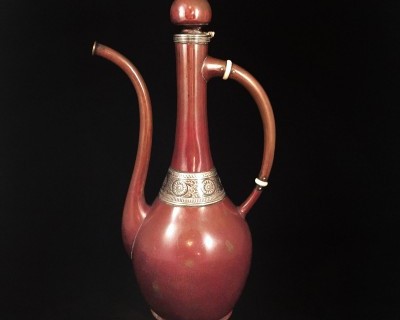
The World in the Nickersons' House: Gorham Manufacturing Company Coffee Pot
This matched set of ‘Turkish’ coffeepots, located in the Sitting Room, are not from Turkey. They were made by the Gorham Manufacturing Company of Providence, Rhode Island in 1882 in the Arabesque style.

Goblet Designed by Tiffany & Co. to Honor Andrew Carnegie
This commemorative goblet in the form of a thistle was produced by Tiffany & Company on the occasion of a dinner held in honor of Andrew Carnegie and hosted by the Engineers Club of New York on December 9, 1907.

Designed for the Artistic House
Interiors of the Aesthetic movement, often referred to as artistic interiors, incorporated various historical styles of architecture and decorative arts. The Japanesque – reflecting the influence of the arts of Japan – was particularly in evidence. The Driehaus Museum’s mantel clock, with its Japanesque tiles, embodies the characteristics of an artistic house.

Teamwork in Art Nouveau Design: Tiffany and Colonna
Though small in scale, this vase has a dramatic presence. It showcases a joint effort between three designers and craftsmen of the late nineteenth century: Louis Comfort Tiffany, who designed the vase, Edward Colonna, who created the mounts, and Eugène Feuillâtre, who enameled the mounts.

The Origins of Lustreware: Recapping Over Ten Centuries of Aesthetic Pottery
Lustreware has a long history that begins in Mesopotamia and spans the globe. Learn more about English lustreware and the pieces currently on display in the Library of the Driehaus Museum.
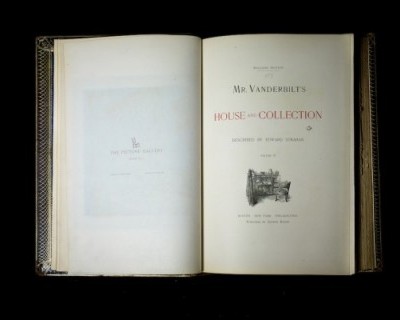
[New Acquisition] Mr. Vanderbilt’s House and Collection
Mr. Vanderbilt’s House and Collection (1884), a beautifully bound two-volume set that brings to life William H. Vanderbilt’s monumental “Brownstone Twins” and their contents on New York’s Fifth Avenue, is now on view in the Sculpture Gallery at the Driehaus Museum.
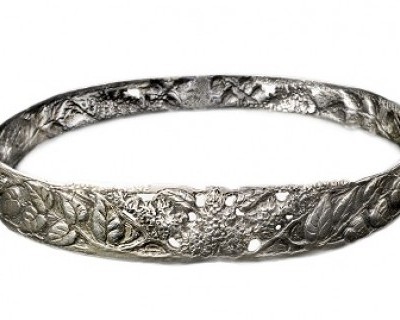
Christina M. Reade and the Lilac Festival Crown
The elegant circlet is repossé silver, crafted from melted silver spoons donated by the women of Lombard, Illinois, in 1930. It was created as a symbol of Lilac Time, the annual springtime celebration in this west-suburban village. The crown adorned the first Lilac Festival Queen—whose name and the names of several other early Queens are etched in the crown’s interior—and continues to be an integral part of the festivities today.
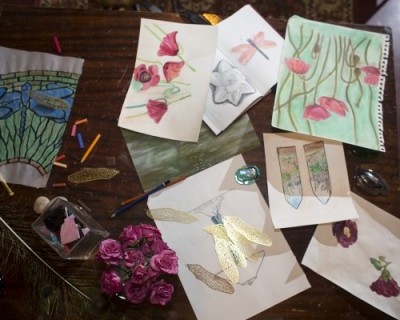
Susan Vreeland Visits the Museum
The Tiffany Girls faced their toughest critic since the old master himself during a recent twilight tour at the Driehaus Museum. Susan Vreeland, author of the acclaimed bestselling novel, Clara and Mr. Tiffany, was the featured speaker at the Driehaus Winter Book Club this March. She also gave two lectures at the museum on the Women’s Department at Tiffany Studios. Vreeland provided some valuable insights as she accompanied “Clara Driscoll” and “Agnes Northrop” on a historic reenactment through their temporary studio and showroom in the Nickerson Mansion.

[From the Collection] Landscape by Agnes Northrop
As we draw nearer to the opening of the Louis Comfort Tiffany exhibition, this work—created by one of the artists he employed—is a fitting one to stop and enjoy for a moment. On view in the Drawing Room on the mansion’s first floor, it is an elegant and simple painting with quite a history behind it, one which has only recently come to light.
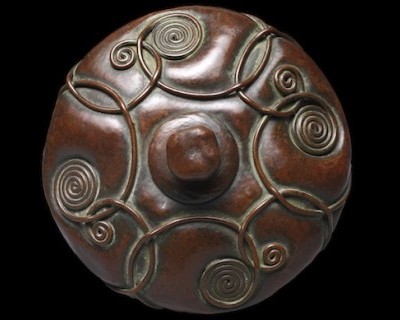
[From the Collection] Tiffany Studios Humidor, c. 1902-10
This fanciful blown-glass work by Tiffany Studios always stirs the curiosity of visitors to the Reception Room. Despite appearing to be just an objet d’art to admire, it is designed to serve a function—as a humidor, used to preserve tobacco in an airtight space.
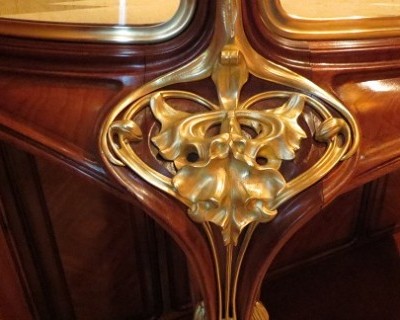
[Featured Designer] Louis Majorelle (and the “Les Orchidées” Vitrine)
Louis Majorelle made a splash at the Exposition Universelle in Paris in 1900 at a precise and brief moment in European art history.
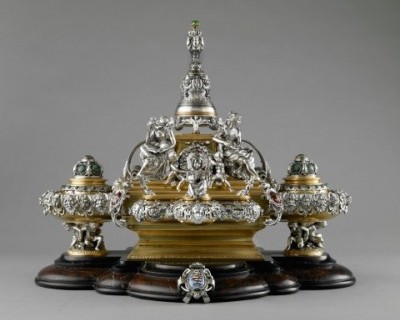
[From the Collection] Jewel- and Gem-Set Inkstand, 1864
This inkstand from the Driehaus Collection packs some of the most eye-catchingly elaborate designs and materials into a small and functional space.