Deep Dive: The Nickerson Mansion
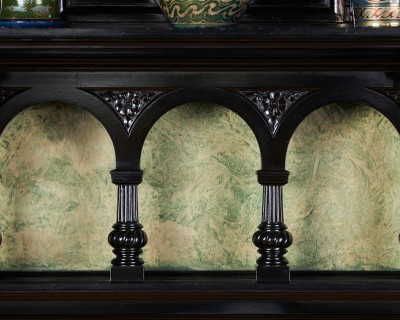
Ebonized Wood in the Driehaus Museum
What is ebonized wood?
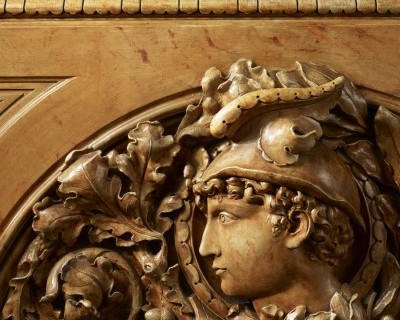
Hidden in the Woodwork: Searching for the Meaning of Acorns at The Driehaus Museum
Why are there so many acorn motifs in the Driehaus Museum?

Resplendent Ornament: Two Nineteenth-Century Approaches
In the late 19th century, Eclecticism and theories of ornament shaped the distinct vision of the Nickerson Mansion and the architectural ornament created by Louis Sullivan.

From Hand to Hearth: The Maher Gallery Fireplace Restoration
Chris Botti and his design studio, having worked on many illustrious art glass restoration commissions in Chicago and beyond, beautifully restored the Nickerson Mansion's Maher Gallery fireplace surround by Giannini & Hilgart. Botti's family story reflects the hard-working immigrant background that allowed Chicago to rise (and dazzle) after the Great Fire.

The Nickerson Series: John Gardner Low
When the Nickersons commissioned their Chicago mansion, Low Art tiles, founded by John Gardner Low, were featured prominently throughout the interior decoration.

The Nickerson Series: George Washington Maher
Visitors often cite the Maher Gallery as their favorite space in the Museum. It is the only room in the mansion that was altered in 1901 when the second owner Lucius George Fisher, Jr. hired George Washington Maher to create his trophy gallery. Maher's addition included the room's impressive stained-glass dome and lacquered cherry bookcases for Fisher's rare book collection. A massive wood-burning fireplace was installed and decorated with an Art Nouveau glass mosaic mantle facing of iridescent, opalescent and metallic luster glass.

The Nickerson Series: William August Fiedler
While Burling and Whitehouse were the architects for the Nickerson’s home (built from 1879-1883), the elaborate interiors were the combined work of the highly skilled Chicago-based designers R. W. Bates & Co. and August Fiedler, along with some work by George A. Schastey & Co. Fiedler’s impeccable attention to the smallest elements of style shine in the marble and woodwork throughout the Nickerson Mansion.

The Nickerson Series: Edward J. Burling
Edward J. Burling was, arguably, the first great architect in Chicago – a city of great architects. Along with his partner Francis M. Whitehouse, he was also the architect of the Nickerson Mansion.
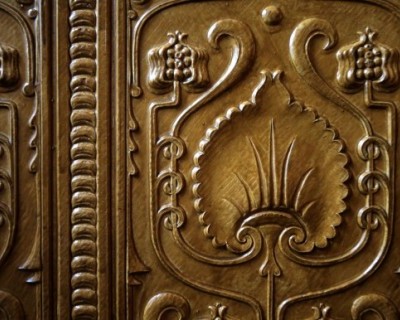
“The Most Perfect and Beautiful of All Wall Decorations”
Standing on the shoulders of the Industrial Revolution, the Gilded Age spawned an astounding number of inventions that profoundly changed life inside the American household. Those last few decades of the 19th century will always be known as a great era of invention.
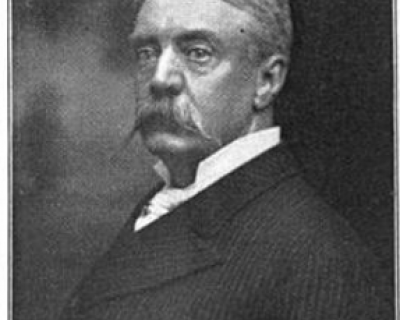
The Story of the Fishers
In the early decades of the 20th century, the fictional Crawley family of Downton Abbey® hosted grand dinners and fretted about the Great War. At the same time, the real Fisher family was doing the same—right here in this Gilded Age mansion the Driehaus Museum calls ‘home.’
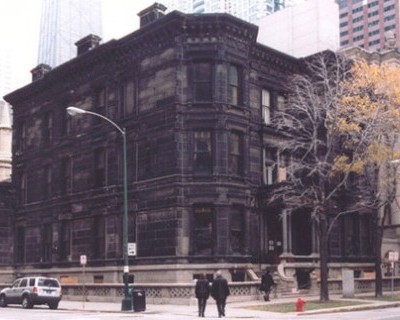
[From the Archives] Didn’t This Building Used to be Black?
Today’s blog is part of an occasional series dedicated to answering visitors’ questions.
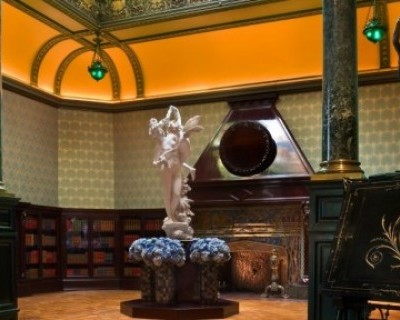
Interior Designers of the Nickerson Mansion: Robert E. Seyfarth
A young architect carved the distinctive lion heads on the lacquered-cherry wood fireplace mantel and the bookcases in the gallery of the Marble Palace. He was Robert E. Seyfarth, (Born 1878, Blue Island, Illinois) and an employee of both August Fiedler and George Washington Maher.
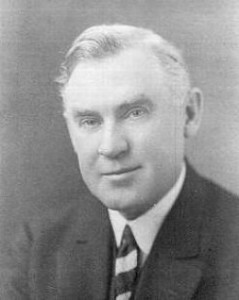
Interior Designers of the Nickerson Mansion: George W. Maher
Visitors to the Driehaus Museum often cite the gallery as a favorite room with its marvelous stained glass dome and massive wood-burning fireplace. Lined with lacquered cherry bookcases and featuring an iridescent mosaic tile Art Nouveau surround, it is the one room in the mansion that was completely redecorated in 1901 thanks to the second owner, Lucius George Fisher Jr.
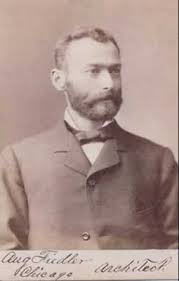
Interior Designers of the Nickerson Mansion: William August Fiedler
“We strongly advocate the use of different styles in different rooms, to avoid the monotonous effect invariably produced by the fanatic apostles of the so-called Eastlake or Modern Gothic. For the same reasons it will be necessary for articles of luxury, as Easels. Hanging Shelves, Cabinets, etc., to use motifs from the Mooresque, Byzantine, Japanese, etc., though diametrically opposed to the prevailing style of the room.” – August Fiedler
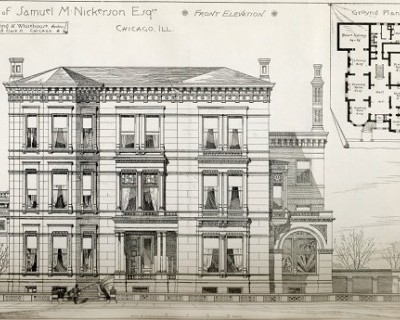
“He Thought it was Architecture Run Crazy”
The Driehaus Museum officially turns five years old today.
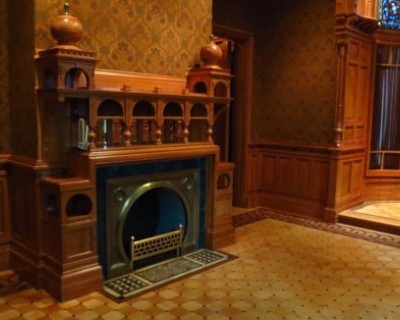
[You Asked] Why Aren’t There Beds in the Nickerson Bedrooms?
Today’s blog is part of an occasional series dedicated to answering visitors’ questions.
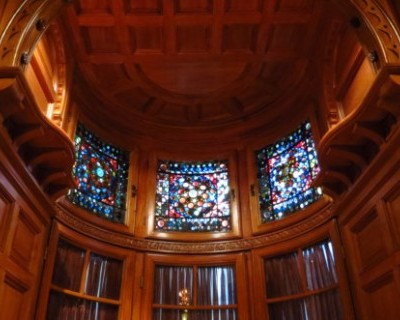
[Speaking of Architecture] The Mihrab Oriel Window
This was a corner room on the floor just below the children’s, and the beauty of it was this window—an oriel window,—projecting beyond the wall, as such windows do, and so exactly at the corner that you could see, so to say, three ways at once when you were standing in it . . . a charming watch tower.”
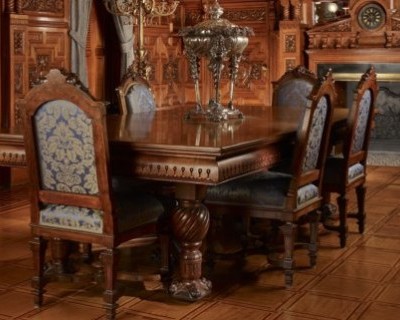
[From the Collection] Herter Brothers Dining Table, 1883
This Herter Brothers dining table is a significant piece in our collection, for its beauty as well as its history.

After the Fire, Quarries Dynamited
The woman The Wire called a “bassoon colossus” treated us and our visitors here on Saturday to live performances of a work inspired by the Driehaus Museum’s unique architecture and history.

[You Asked] Didn’t This Building Used to be Black?
You Asked… Didn’t the Nickerson Mansion used to be black? And how did conservationists manage to clean the exterior?
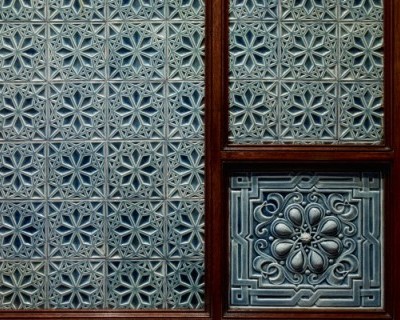
[Featured Designer] John Gardner Low
John Gardner Low was a ceramics artist of about 41 when he approached the crowded exhibitions in Philadelphia at the 1876 Centennial Exposition. He was a Massachusetts man and had traveled far, like the millions of others, to see the first U.S. world’s fair.