The Origins of Lustreware: Recapping Over Ten Centuries of Aesthetic Pottery
February 02, 2021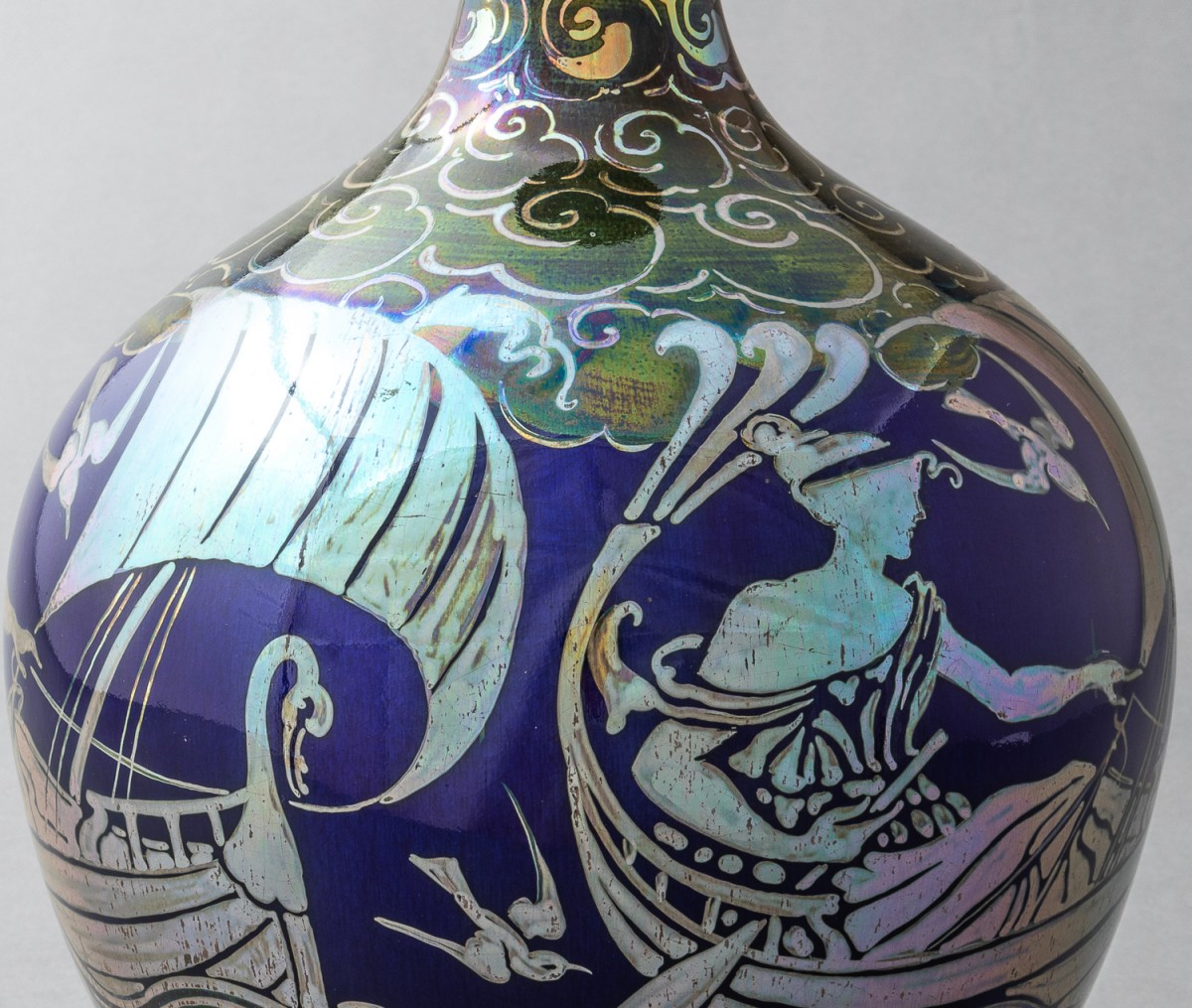
Contributed by Alina Taber
Besides the gleaming Tiffany Favrile glass on display at the Driehaus Museum, among the other shiny objects that can be seen - ceramic lustreware. Lustreware refers to a style of pottery decorated with metallic oxided glazes which provides an iridescent effect. The process involves two firings: the first adds the color, the second, the lustre. The magic of lustreware begins in Mesopotamia, specifically during the 9th century C.E, in the Abbasid Caliphate. The concept of lustreware spread quickly, moving to Egypt, which becomes the major center of lustreware production in the Islamic world. The technique soon makes its way through the Islamic Middle East and North Africa. After Muslims conquer Spain, it too becomes a center for lustreware and the glazing technique becoming synonymous with the country.

By the 14th century, lustreware is found in Iraq and along the Northern rim of the Mediterranean. Complex geometric patterns in striking cobalt blues were overlaid in variations of gold lustre and warmer tones. The origin of this blue, as seen in this piece of Spanish lustreware, is contested. Some argue its origins came from the Tang Dynasty in China, others say Persia. Wherever its origin, its popularity by the 14th century is apparent. As lusterware spreads to the Christian world, designs begin to include new symbols, such as coats of arms and crosses. Around the same time, lustreware appears as Maiolica (Majolica) in Italy via Sicily.
Five hundred years later in the 19th century, William De Morgan (1839-1917), rediscovers the process of lustreware (after one thousand years of existence), and introduces it to the English Aesthetic Movement. Makers experiment to perfect and develope new glazing techniques and lusterware gets a new look. One method, the Resist Technique, allows glaze to be painted on or to be utilized as a base coat. Another technique, created by the Germans but quickly usurped by the English, created the illusion of solid gold or silver. The techniques revived in England spread throughout the British empire and the world, reaching as far as Japan.
 Image left: Walter Crane R.W.S. (English, 1845-1915) Sea Maiden Vase, 1914. Earthenware. The Collection of Richard H. Driehaus, Chicago. (With base pictured underneath.)
Of the lustreware on display in the Library at the Driehaus Museum today, three pieces come from the little known firm Pilkington’s Royal Lancastrian Pottery Company, established in 1892 in Lancashire, England. At the time, Lancashire was one of the major pottery centers of England. Pieces of Royal Lancastrian served as shining examples of art pottery that came out of the Arts and Crafts movement. Royal Lancastrian produced prime examples of “modern” lustreware, creating art pottery in a variety of unique and original lustre glazes. The company employed superb designers. These three vases can all be attributed to William S. Mycock (1872-1950), a resident designer of Royal Lancastrian. Little is known about Mycock but we do know that he made hundreds of designs for the company, which continued to produce pottery until the 1930s.
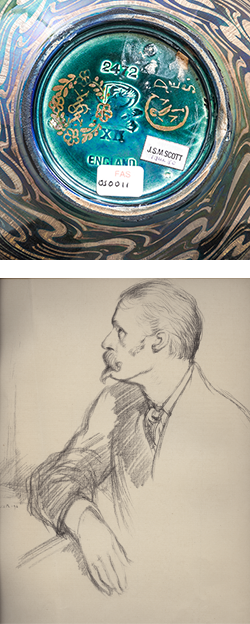
Image left, bottom: Sir William Rothenstein (British, 1872-1945). Portrait of Walter Crane (British artist and designer, 1845-1915), Published in PAN II, Volume 3, 1896, Lithograph. Featured in the Driehaus Museum's current exhibition, PAN: Prints of Avant-Garde Europe, 1895-1900.
The Sea Maiden vase (1912) pictured here was designed Mycock and Walter Crane. Crane is the most influential British children’s book illustrator of his time, though he also branched out into the decorative arts. The Driehaus Museum’s piece is glazed with a particularly pearlescent lustre. The design illustrates a strong scene- a female figure pointing forward in a stately ship amongst curling waves and burly clouds. A swallow (the bird of choice in the Arts and Crafts Movement) flies alongside the ship, indicating that land is near. Produced by Royal Lancastrian, the design itself was quite popular and appeared on a variety of pottery forms using different glazes. Ceramics, like everything else man-made, are subject to fashion. Lustreware as it exists in its inventive form has fallen out of favor in modern manufacturing, however, antique lustre pottery is a popular collector’s item, and practical lustre dishware dating well into the 20th century is still in demand. Perhaps some time in the near future, new lustre glazing techniques will find themselves once again at the forefront of modern design.
Sources
Caiger-Smith, A. Lustre Pottery: Technique, Tradition and Innovation in Islam and the Western World, 1985, Faber & Faber.
Corbett, A & B. Pilkington's Lancastrian and Royal Lancastrian Pottery: a Guide for Collectors, 2016, Pilkington’s Lancastrian Pottery Society.
Savage, George. “European: to the end of the 18th century.” In Encyclopedia Britannica, August 18, 2020. https://www.britannica.com/art/pottery
Wikipedia contributors, "Pilkington's Lancastrian Pottery & Tiles," Wikipedia, The Free Encyclopedia, https://en.wikipedia.org/wiki/Pilkington%27s_Lancastrian_Pottery_%26_Tiles