A Tale of Today: Up From the Ashes
Rebuilding Chicago
October 20, 2020

Contributed by Ryan McKibben, Driehaus Museum Interpretive Guide
Gilded Age Chicago developed in the shadow of the Great Chicago Fire. On October 8th, 1871 conditions within the city were ripe for disaster. According to reports, a combination of dry weather and primarily wooden architecture allowed a small spark near the barn of Catherine and Patrick O’Leary at 137 DeKoven Street to blossom into an inferno that raged through October 9th until finally burning itself out on the 10th. While certain parts of Chicago’s physical infrastructure such as roads remained intact, many of its buildings were destroyed. Furthermore, the toll it took on the city’s mentality was enormous. As chaos reigned and looting spread, martial law was declared on the 11th in order to keep the peace and lasted for several weeks.1
The scale of this disaster was not lost on Chicago’s populace. This excerpt from the October 11, 1871 Chicago Tribune details just how debilitating the fire was for this fledgling metropolis: “A fire in a barn on the West Side was the insignificant cause of a conflagration which has swept out of existence hundreds of millions of property, has reduced to poverty thousands who, the day before, were in a state of opulence, has covered the prairies, now swept by the cold southwest wind, with thousands of homeless unfortunates, which has stripped 2,600 acres of buildings, which has destroyed public improvements that it has taken years of patient labor to build up, and which has set back for years the progress of the city, diminished her population, and crushed her resources.” 2 Despite this tragedy, the Great Chicago Fire also created opportunity for architects, artisans, and working-class laborers to rebuild Chicago into a stronger city with a stronger community. These opportunities also presented a renewed sense that a successful and abundant life was possible.
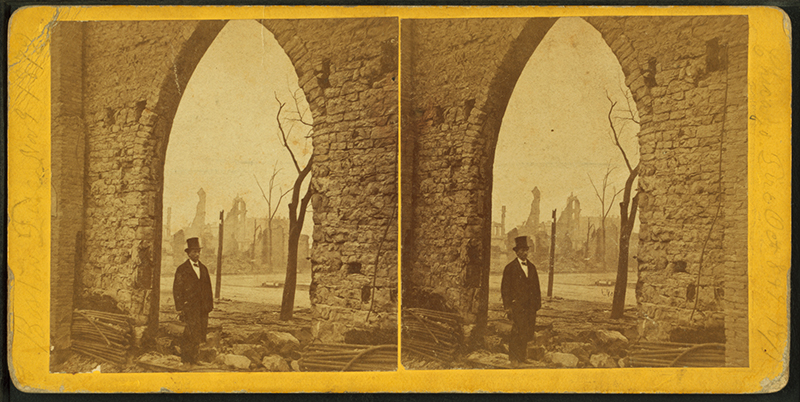
Tribune building and Custom House from interior Second Presbyterian Church, 1871. Image courtesy of The New York Public Library Digital Collections. Accessed on October 21, 2020.
In the wake of the Great Chicago Fire, the effects of the rapid growth environment of the Gilded Age had an impact on the revitalization of the city that cannot be understated. Immediately after the fire over ten thousand building permits were issued (between 1872 and 1879), a testimony to the determination of the city to rebuild and the speed at which it did so.3 Further, the Gilded Age saw the creation of life-changing technologies, new waves of immigrants bringing in new skills and cultural traditions, and an expression of immense wealth through the design and production of groundbreaking works of architecture, such as the Nickerson Mansion. This unprecedented explosion of development came hand in hand with crucial industrial innovations such as the expansion of railroads, ushering Chicago to become the urban hub that it is today. Great architects and designers such as Edward J. Burling, R.W. Bates, William August Fiedler, and George A. Schastey made their names from creating some of Chicago’s most notable historical structures. However, the story of Chicago’s rebirth in the wake of the Great Chicago Fire is a tale of two cities. This blossoming era of industry and creativity came hand in hand with widespread class struggles, strikes, and riots as workers fought to assert their rights and to improve their lives in the growing metropolis.
Edward J. Burling was among the first and certainly among the greatest of the architects who helped build Chicago. As detailed in our 2013 profile of Burling, he already had a storied career leading up to the Gilded Age. He arrived in Chicago in 1843 at the age of 24, establishing his own firm the following year. In the following decades he would design such buildings as the first Chicago Chamber of Commerce and St. James Cathedral. The Great Chicago Fire destroyed much of his work but this loss would both strengthen Burling’s resolve and increase demand for his designs. As such, in 1879 he (alongside his then-partner, Francis M. Whitehouse) was commissioned by Samuel Mayo Nickerson to design the Nickerson Mansion.4

Elevation drawing for the Nickerson Mansion
The work of architects like Burling would not have been possible without the efforts of Chicago’s working class. During the Gilded Age many workers of various backgrounds in Chicago began to grow dissatisfied with working conditions and wages. The rebuilding of Chicago led to an environment with a clear and growing need to provide for the well-being of the working class and their families. Philanthropic and civic-minded citizens organized with them to begin planting the seeds for social reform. The late 1870s and the 1880s witnessed the “Great Upheaval” during which workers of various occupations across the nation, including Chicago, began to unionize. Chicago’s working class organized riots and strikes, such as the 1877 railroad strike that saw almost the entire city come to a halt as workers and law enforcement clashed. The 1880s saw these dissatisfied workers organize into even stronger labor groups to agitate for livable working conditions.5 Of note was an organization called the Knights of Labor, founded in 1869 by Irish immigrants in Philadelphia. They spread to Chicago in the late 1870s and sought to organize workers of all backgrounds, including African Americans and women.6 This kind of solidarity gained momentum in Chicago at the perfect time: the city was working together to rebuild, and those doing the building found a pathway to advocate for themselves.
Struggles for proper wages and working conditions took place on a more personal scale as well. In a letter dated May 22nd, 1881, young architect D. Davis describes his experiences working on the Nickerson Mansion. This included negotiating with Bates for pay and contract details:
“Bates offered me $10.00 per week but finally gave me $13.00 when I would not take less, and tried to have me contract for two years instead of one, which I would not do. The evening after the day I pledged myself to Bates, Addison & Fiedler offered me $14.00 per week by the year. Bates was sharp and forced me to a contract before my time ran out, so others should not have a chance to make me offers.”7
Davis’ experience was atypical compared to the everyday struggle of the individual worker in the building of Chicago. Large firms such as those of Bates and Burling employed many construction workers; in fact, construction firms were among the biggest employers in Chicago in the late nineteenth century. Most workers did not have the privilege of having their work bid up as Davis did; instead, they had to struggle to secure a living wage. The increasing diversity of Chicago’s populace combined with the increased demand for labor in the wake of the Great Fire necessitated both wide-scale organization of laborers and individual desire to have one’s working conditions improved.
The Great Upheaval was not to last, however. In the period between April 25th and May 4th of 1886, the movement reached a fever pitch causing law enforcement to crack down on protestors with violence. On May 4th a crowd gathered in Haymarket Square to peacefully protest unfair working conditions. This was until someone hurled a bomb at the police, who began firing into the crowd in what is now known as the Haymarket Riot. 8 Notable Chicago labor activist and anarchist Albert R. Parsons, a frequent collaborator with the Knights of Labor, was present during the Haymarket protest but left before violence broke out. However, Parsons and three others would be executed in the aftermath of the Riot. A combination of this kind of retaliation by law enforcement and internal corruption among the labor movements led to the collapse of many labor movements in Chicago by the end of the 19th century.9

A notice for a gathering of the Knights of Labor, with Chicago labor activist Albert R. Parsons speaking. Image courtesy of the Chicago History Museum.
Despite this, these labor movements helped shape the Gilded Age by reaching the people who built Chicago and served as a basis for great reform in the 20th century. From the ashes of the Great Chicago Fire, the city was newly shaped by the vision of great architects and the hands and minds of workers of various ethnicities, backgrounds, and genders. And while architects such as Burling should be remembered for their grand designs, it is important to remember that behind those great designs were everyday people reaching a turning point for the working class in Chicago. Each of these architects and workers has their own history, a story waiting to be told.
1 History.com Editors. “Chicago Fire of 1871.” HISTORY, A&E Television Networks, 4 Mar. 2010, www.history.com/topics/19th-century/great-chicago-fire.
2 Chicago Tribune (Chicago, Ill.), 11 Oct. 1871. Chronicling America: Historic American Newspapers. Lib. of Congress. www.chroniclingamerica.loc.gov/lccn/sn82014064/1871-10-11/ed-1/seq-1.
3 Jo Ann Rayfield, “Tragedy in the Chicago Fire and Triumph in the Architectural Response,” Illinois History Teacher 4:1 (1997) : 35.
4 “[Speaking of Architecture] The Life and Work of Edward J. Burling.” Driehaus Museum, Richard H. Driehaus Museum, 28 June 2013, driehausmuseum.org/blog/view/speaking-of-architecture-the-life-and-work-of-edward-j.-burling.
5 Barrett, James R. “Unionization.” Encyclopedia of Chicago History, www.encyclopedia.chicagohistory.org/pages/1284.html.
6Schneirov, Richard. “Knights of Labor.” Encyclopedia of Chicago History, www.encyclopedia.chicagohistory.org/pages/693.html.
7 Davis, D. “Untitled Letter.” Received by Mason, This House Was the Pride of the Town: Mr. Nickerson's Marble Palace Becomes Mr. Driehaus' Museum, Cottontail Productions, 12 May 2008, pp. 13–15.
8 Thale, Christopher. “Haymarket and May Day.” Encyclopedia of Chicago History, www.encyclopedia.chicagohistory.org/pages/571.html.
9 Barrett, James R. “Unionization.” Encyclopedia of Chicago History, www.encyclopedia.chicagohistory.org/pages/1284.html.