Elegance in Glass
April 01, 2025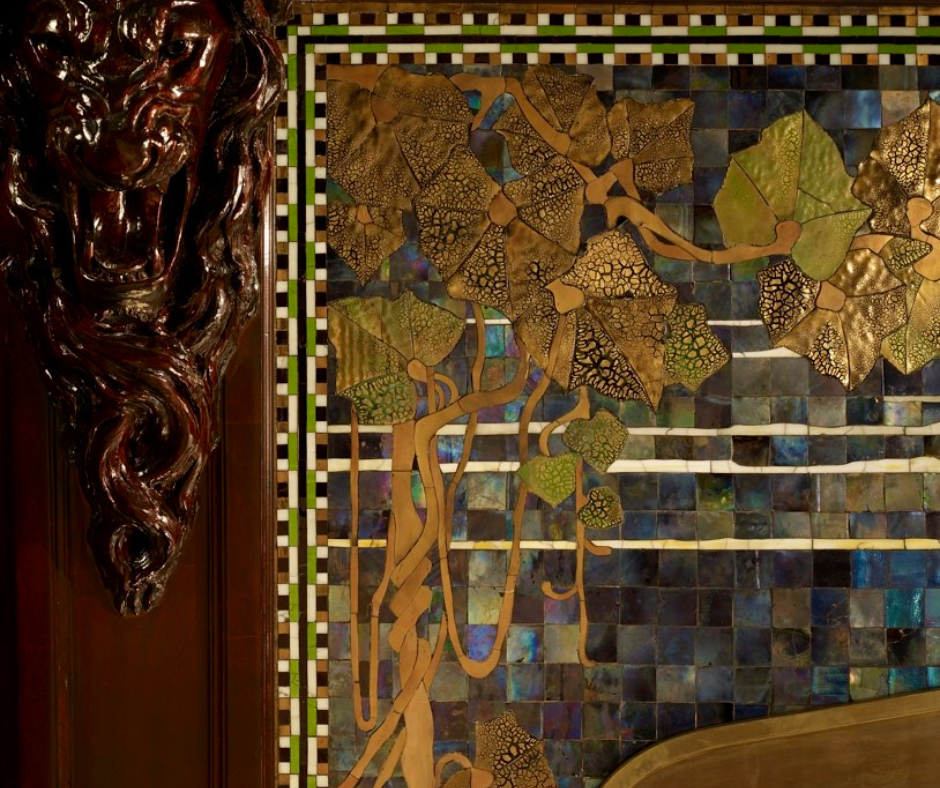
This blog post was written by Sarah Gawo as part of her work in Loyola University of Chicago's Master's of Public History.
Located on the Near North Side in Chicago, the Driehaus Museum engages visitors by highlighting the art, architecture, and design of the late 19th and early 20th centuries. The unique opalescent glass mosaic fire surround in the Musem's Maher Gallery is one of the Museum's highlights. Conceived and executed by Giannini & Hilgart, a Chicago-based design company founded in 1899, the fireplace is a reflection of both the wealth of those who resided in the Driehaus Museum's Nickerson Mansion and Giannini & Hilgart’s brand. “While well known for their residential, commercial and ecclesiastical art glass windows, they also produced extraordinary mosaics, fireplace surrounds, mantels, tiles and lighting” [1]. Giannini & Hilgart’s success stemmed from their ability to blend artistic, decorative, and cultural trends into each piece of their work.
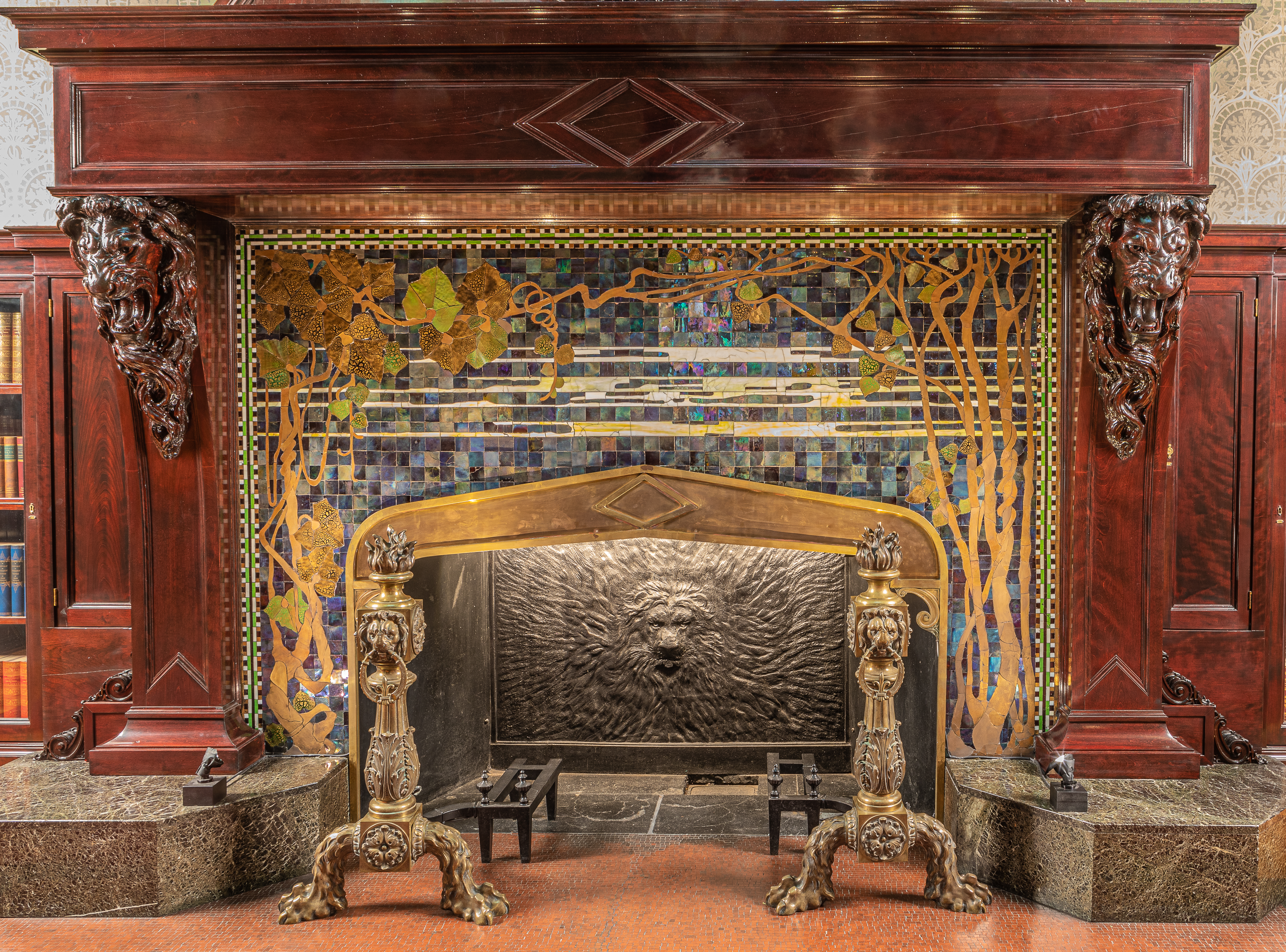
This image, taken by Michael Tropea in 2020, showcases the entire fireplace [3].
Orlando Giannini and Frederick (Fritz) Hilgart founded their workshop during the golden age of craftsmanship. “The partners created stained glass windows and mosaics for numerous architects, including Frank Lloyd Wright, as well as glass lampshades for popular Teco pottery lamps” [4]. Their partnership enhanced the firm’s recognition. Giannini & Hilgart's stained-glass work captured the era's aesthetic values in the United States, which integrated art seamlessly with architectural elements of the Art Nouveau movement. Art Nouveau was a distinctive artistic style that combined freedom of form with inspiration from nature and romantic or historical themes while also merging art and craftsmanship, aesthetics and functionality, across traditionally siloed artistic boundaries [5].
_1905_1.JPG)
This is one of Giannini & Hilgart studio’s catalog cover illustrations from 1905 displaying decorative glass and glass mosaics [6].
The Art Nouveau movement emphasized creating work not only for the sake of decorative art but, as part of interior design or decor, it was also meant to enhance the spirit of the room. True to the tenets of Art Nouveau, which believed nature was a unifying force and represented the shift toward modernity, the fireplace surround has a distinct form resembling natural shapes. [7] [8]. In this context, the fireplace becomes a focal point that not only enhances the environment but also complements the aesthetic of the Maher Gallery.
The fireplace surround contains colors ranging from pale greens and yellows to opaque deep blues. It is a fine example of a harmonious design that balances light and color to create an ethereal impression. Like many stained-glass pieces and mosaics, when natural light shifts throughout the day, the colors within the glass change to add a sense of movement. This choice of glass gives a timeless appearance to the mosaic, making it come alive with changing light. From hour to hour, minute to minute, it never quite looks the same.
Giannini & Hilgart’s work, like the Driehaus Museum itself, is a testament to an era that revered craftsmanship, design, and decoration. Their work showcases the broader artistic trend of Art Nouveau as it also captures the shimmering prosperity in America during a period of economic growth better known as the Gilded Age.
The Giannini & Hilgart firm still exists in Chicago today under different ownership [10].
Notes:
[1] Colin Hansford. “Giannini & Hilgart, Company Details.” LeadedLamps.com. Accessed November 10, 2024. https://www.leadedlamps.com/GianniniHilgart/gianninihilgart.html.
[2] Paul Neumann. “From Hand to Hearth: The Maher Gallery Fireplace Restoration.” Web log. Driehaus Museum (blog). Driehaus Museum, November 24, 2020. https://driehausmuseum.org/blog/view/from-hand-to-hearth-the-maher-gallery-fireplace-restoration.
[3] Steve Hall, [Maher Gallery Fireplace], 2020, photograph, Driehaus Museum, https://driehausmuseum.org/blog/view/from-hand-to-hearth-the-maher-gallery-fireplace-restoration
[4] “Artist / Studio.” Michigan Stained Glass Census. Accessed November 10, 2024. https://www.michiganstainedglass.org/collections/studiosartist.php?id=208-791-106.
[5] Mateusz Siniło. “Exploring Art Nouveau: The Power of Nature, Asymmetry, and Freedom of Form — History of Art #4.” Play For Thoughts, n.d. https://www.playforthoughts.com/blog/art-nouveau.
[6] "Giannini and Hilgart Studios: decorative glass, glass mosaic, ecclesiastical and domestic memorial and figure windows," 1905, MBJ Collection, Internet Archive, https://archive.org/details/GianniniAndHilgartStudiosDecorativeGlassGlassMosaicEcclesiastical/page/n1/mode/2up.
[7] Janet L. Whitmore. "Chicago as an Art Nouveau City - Strand 1: Art Nouveau Cities: between cosmopolitanism and local tradition" (PDF). Art Nouveau European Route : Congress.
[8] Mateusz Siniło. “Exploring Art Nouveau: The Power of Nature, Asymmetry, and Freedom of Form — History of Art #4.” Play For Thoughts, n.d. https://www.playforthoughts.com/blog/art-nouveau.
[9] Steve Hall, [Fireplace Mosaic Close-up], 2008, photograph, Driehaus Museum, https://driehausmuseum.org/blog/view/the-nickerson-series-george-washington-maher
[10] William Tyre. “The Windows of Howard Van Doren Shaw.” The Herald, 2012.