Anne Lee Willet: The Unsung Artisan of a Stained-Glass Legacy
April 02, 2025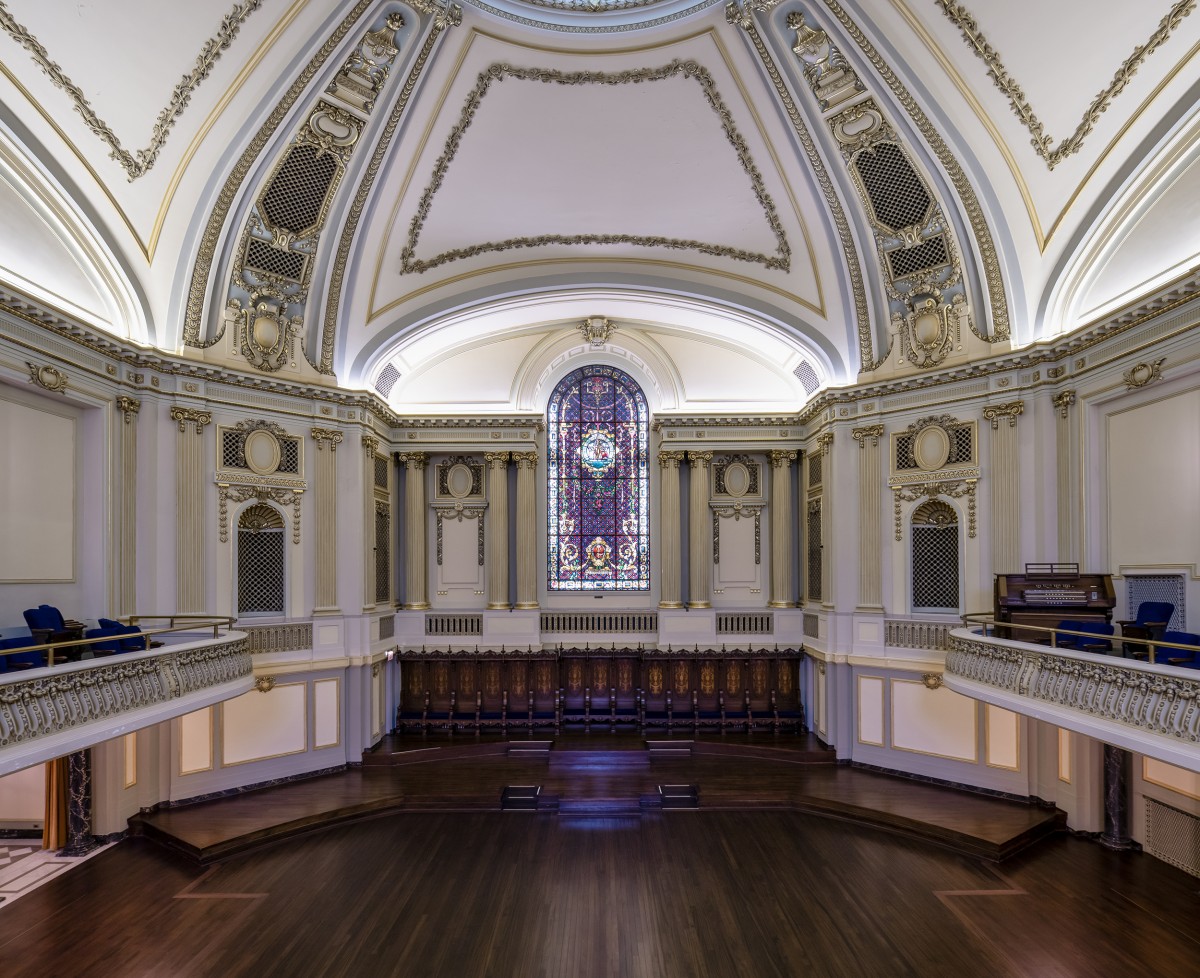
This blog post was written by Eira Brown as part of her work in Loyola University of Chicago's Master's of Public History.
In the world of fine arts, it is often the case that women’s creative contributions are overshadowed by the more well-known male figures of their time. Anne Lee Willet, an accomplished stained-glass artist in the early 20th century, exemplifies one such figure. Despite her pivotal role in the success of the stained-glass company she co-founded with her husband, William Willet, Anne’s work has not received the full recognition it deserves. Her extraordinary artistry, notably reflected in the stained-glass windows of the Murphy Auditorium at the Nickerson House in Chicago, deserves to be celebrated as an important part of American art history.
The Founding of Willet Stained Glass Studio
In 1898, Anne Lee Willet and her husband William Willet established the Willet Stained Glass and Decorating Company in Pittsburgh, moving to Philadelphia shortly thereafter [1]. Their business would become one of the most influential stained-glass studios in the United States. While William Willet often claimed credit for leading the company, Anne played a role with far more depth than just that of a supportive spouse. She developed into a skilled artist and a key figure in the design and execution of many of the studio’s most celebrated windows and continued leading the company after her husband’s death in 1921 [2].
At a time when traditional, religious themes dominated the world of stained glass, Anne Lee Willet pushed the boundaries of what the medium could achieve. Through her innovative use of color, texture, and light, her techniques transformed stained glass from simple decorative pieces to integral, immersive components of architectural design. Under her artistic direction, the Willet studio produced windows for some of the most prestigious churches, universities, and public buildings across the country [3]. Yet, despite her pivotal role in the studio’s success, much of her contribution remains overlooked, overshadowed by her husband's name and public persona. Much like other women throughout history, the art world—and society as a whole—reduced her contributions to that of a “supporting role.” In truth, Anne Lee Willet acted as an equal partner in the company’s success, contributing not just to the artistic direction of the business, but also to the design and execution of some of its most celebrated pieces.
The Murphy Auditorium Window: A Masterpiece of Innovation
One of the most striking examples of Anne Lee Willet’s genius can be found in the Murphy Auditorium of the Nickerson House in Chicago. There, a stunning stained-glass window, created by Willet in 1910, exemplifies her mastery of the medium and her innovative approach to incorporating light and color into architectural spaces [4]. It is worth noting that Anne’s design beat out that of the famed Tiffany Studios [5], further exemplifying her mastery and talent. Departing from traditional religious methods and imagery of the time, Anne’s window incorporates symbolic motifs of Greek mythology and Native American tradition as well as decorative elements expertly combining Gothic, Renaissance, and Baroque styles [6].


The window is a large, intricate design that features a dynamic interplay of vibrant hues, subtle shading, and delicate textures. The window is not just a decorative element; it becomes a living part of the architecture. The way light interacts with the window throughout the day—shifting and changing—adds a sense of movement and depth to the room. This integration of light, color, and design was one of Anne Lee Willet’s hallmarks, as she understood that stained glass could be much more than a static ornament; it could actively shape the atmosphere of a room.
Anne Lee Willet's Innovative Approach to Stained -Glass
Willet's contributions to stained glass were deeply innovative, and she broke away from the conventional techniques of her time. While many stained-glass artists of the period relied heavily on painting the glass to create images, Anne Lee Willet pushed the medium’s limits by incorporating more complex color and texture within the glass itself. Her style allowed for a richer, more varied interaction with light, a departure from the flat, two-dimensional designs that characterized much of stained-glass work before her time. Her technical innovations paired with her imaginative designs and symbolic integrations made for incredible pieces that withstand the test of time.
Anne also used her expertise to integrate stained glass more fully into the architectural environment, seeing it as a part of the broader design rather than a standalone element. She designed her windows to respond to their surroundings, complementing and enhancing the architectural spaces they inhabited. This holistic approach to stained glass not only brought greater visual complexity to the medium but also transformed how stained glass could be used in modern architecture.
Anne Lee Willett and Camille Claudel: A Parallel Legacy
Despite Anne Lee Willet’s immense contributions, her husband’s name, William Willet, historically overshadowed her own. While William certainly worked as a key figure on the business side of the Willet Stained- Glass Studio, it was Anne who acted as the dominant creative force behind much of the studio’s artistic success. Unfortunately, the prevailing historical narrative tends to focus on the male artist, leaving Anne’s innovative and technical expertise largely uncredited.
This phenomenon of downplaying female artists is not unique to Anne Lee Willet. A striking parallel can be drawn to the story of Camille Claudel, for example, the French sculptor who worked alongside Auguste Rodin. Rodin’s fame often overshadowed Claudel's genius, and much of her contribution either became attributed to him or ignored altogether [9]. Only in recent years has Claudel’s work begun to receive proper recognition, shedding light on her unique style and contributions to the art world. Similarly, art history has unduly relegated Anne Lee Willet’s prowess to the margins—let this story be a call, then, to bring her forward into the light in a way that illuminates her contributions in all their colors, textures, and visions.
Recognizing Anne Lee Willet’s Artistic Contributions
It is time to revisit Anne Lee Willet’s role in American art history and give her the recognition she deserves. Her use of color, light, and texture elevated stained glass from a decorative craft to an art form that could stand alongside any other in the architectural realm. As a woman who worked alongside her husband in a company that flourished in a field dominated by men, Anne Lee Willet's legacy deserves to be celebrated independently of her husband's fame. She should be known not just as a partner in her husband’s business but as an artist in her own right, shaping the course of stained-glass history and influencing the field for generations. As history continues to uncover the stories of overlooked women artists like Camille Claudel, it must also remember Anne Lee Willet and her remarkable legacy. Only by acknowledging her contributions can we truly appreciate the full scope of her impact on the world of stained-glass, architecture, and art as a whole.
Notes
[1] “Our History.” Associated Crafts & Willet Hauser, March 27, 2020. https://stained-glass-window.us/history-of-associated-crafts-and-willet-hauser-stained-glass/.
[2] “Anne Lee Willet, 1867-1943.” Stained Glass 38, no. 1 (1943): 30–31.
[3] “Willet, Anne Lee (1867 - 1943).” Philadelphia Architects and Buildings, 2024. https://www.philadelphiabuildings.org/pab/app/ar_display_projects.cfm/151567.
[4] “Inside the Driehaus Museum.” Driehaus Museum, 2024.
[5] Tiffany, Louis C., and Tiffany Studios. “Design for Medallion Window for the American College of Surgeons, Chicago, IL.” The Metropolitan Museum of Art. Accessed November 19, 2024. https://www.metmuseum.org/art/collection/search/16465.
[6] Mark Bleakley, “Narrative” (2024).
[7] Associated Crafts & Willet Hauser Stained Glass Studio, 2019. https://stained-glass-window.us/.
[8] “Inside the Driehaus Museum.” Driehaus Museum, 2024. https://driehausmuseum.org/resources-and-research/inside-the-driehaus-museum.
[9] “Camille Claudel.” Library of Congress Research Guides. Accessed November 1, 2024. https://guides.loc.gov/feminism-french-women-history/famous/camille-claudel.