A Tale of Today: Up From the Ashes – The Spirit of Giving
December 10, 2020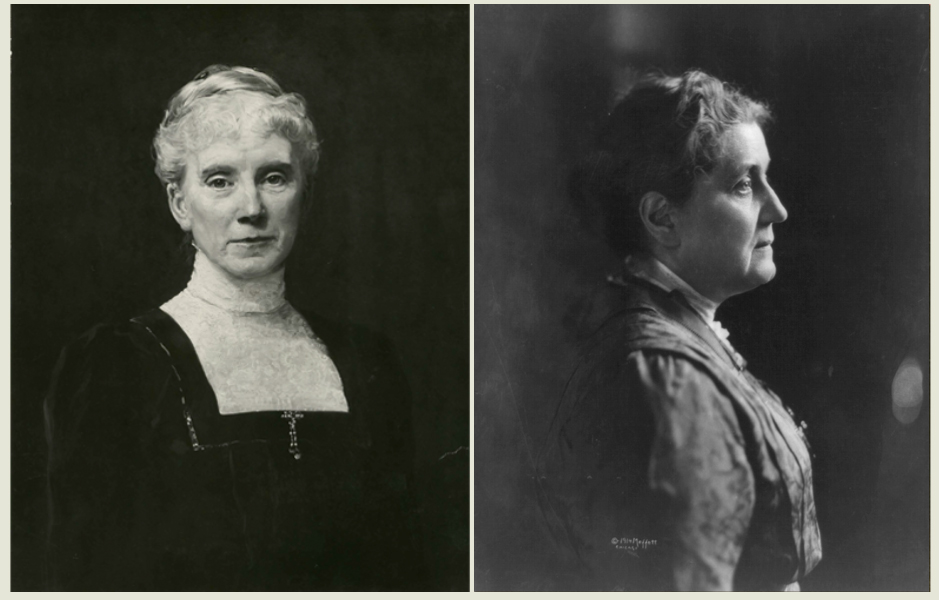
Contributed by Ryan McKibben
This holiday season, amongst the traditions of carols, cards, and twinkling lights, we take time to give generously and to be thankful for the kindness of those around us. During the Gilded Age, some of Chicago’s first philanthropists laid the foundation for the public and cultural institutions we continue to enjoy today. At a time marked by the effects of war, fire, and rapid urbanization, these citizens acted at a critical juncture in the city’s history as leaders in a growing tradition of philanthropy in America. The Nickersons were amongst them, providing spaces for culture and art to flourish as they shared their private art collection with students in their home, and later through the galleries they founded through a donation to the Art Institute of Chicago in 1900.
At the same time, another Chicago house was transformed into a center for civic unity. Hull-House, founded by Jane Addams, provided for immigrant workers in a poor industrial community within this burgeoning metropolis. The center she envisioned as a “Cathedral of Humanity,” became a place where people could come for help with basic needs and where the community could come together for cultural enrichment and educational experiences that enhanced their lives. Hull-House provided the roots for philanthropy and volunteerism to grow in Chicago as immigrants and other women took up Jane Addams’ mantle, such as Lucy McCormick Blair Lynn and Mary Kenney O’Sullivan. Furthermore, both the Nickersons and Jane Addams were immortalized through the establishment of historic houses. As we look at who built Chicago, it is important now more than ever to look at the community structures that enabled them to thrive and seize opportunity as we continue to explore our A Tale of Today.
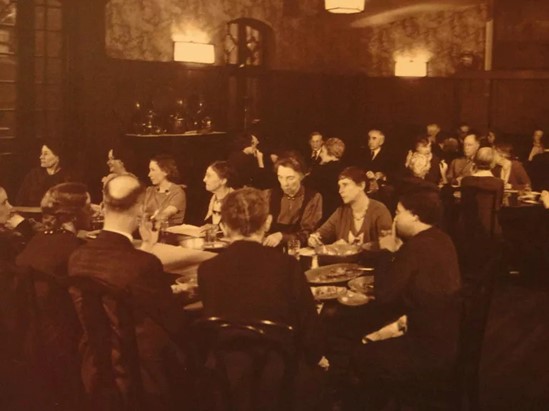
The Great Chicago Fire may have wreaked havoc on the architecture of the city, but it did nothing to stem the influx of immigrants to Chicago. With the dawn of America’s third wave of immigration in the mid-19th century, Chicago quickly garnered a reputation as a city of immigrants. By 1890 seventy-nine percent of Chicago residents were either immigrants or children of immigrants. At first, the majority of these people came from Ireland, Germany, Britain, and Scandinavia.1 However, with the turn of the century, immigrants began to come to Chicago from Southern and Eastern Europe, specifically Poles, Italians, Greeks, and Eastern European Jews.2 Often, these immigrants were faced with poor working conditions and poverty as they tried to make their new life in Chicago. However, Chicago lacked the community infrastructure to provide aid for these groups. Social welfare provided by the government was limited and disorganized, and private outreach groups were few and far between.3
One institution that sought to provide for an often-overlooked immigrant community was Hull-House, established by Jane Addams and Ellen G. Starr in September 1889 with the help of Charles Hull, who leased out the building that would become Hull-House, Chicago’s first settlement house. Addams and Starr were upper-class women who recognized the hardships that newcomers to the city faced. Not only did they decide to use their wealth to create a space for those less privileged, but they would also reside alongside them as neighbors.4 Their neighborhood, Chicago’s Near West Side, was full of immigrants struggling to survive; many found transitioning from rural lifestyles to factory work difficult.5 Furthermore immigrants, including those in Chicago, faced a country that was deeply skeptical of newcomers. The newcomers, initially skeptical of Jane Addams, eventually began to trickle in to find that they had great advocates in the women volunteers of Hull-House and a place where they would receive the help they needed. The work of Hull-House secured better living and working conditions for Chicago’s immigrant population from meals to job search and childcare services, as well as citizenship classes.
As the settlement house developed, more like-minded women such as Julia Lathrop, Florence Kelly,6 and Ida B. Wells-Barnett7 joined the initiative and helped build Hull-House to become Chicago’s first significant philanthropic cornerstone. As more wealthy Chicagoans became donors, Hull-House began to host public art exhibitions and classical music concerts, lectures, and education initiatives covering history, science, and literature.8 Addams also hosted evenings focused on different ethnic groups, featuring food, dance, and informative lectures by working with immigrants to proudly share their cultural traditions and foster cross-ethnic friendships in the community.9
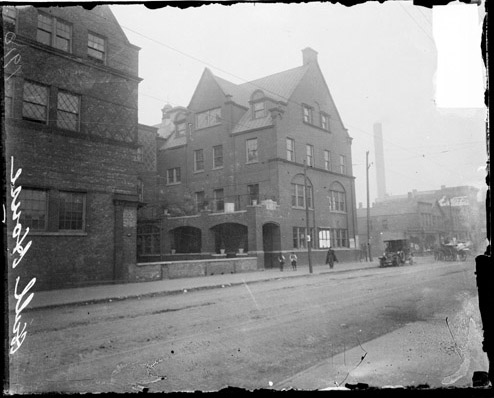

Institutions such as these left impressions on Chicago’s new immigrants. In 1907, the Greek newspaper The Star referred to Jane Addams as “...one of the best friends of Greek people in Chicago.” Hull-House resident Dr. Soter called her the “...sweetest physiognomy, the saintliest woman I have ever known.”10 Children of working-class immigrant families found Hull-House particularly welcoming. Hilda Satt Polacheck, an immigrant child from Poland, was no exception as she recounts in I Came A Stranger. Upon arriving in Chicago, Polacheck’s parents had to immediately find work to support their family, preventing Polacheck from enjoying the vast opportunity of exploring and making connections in her new city. However, through Hull-House she was able to find community and friendship as many other immigrant children did.11
Hull-House served as an inspiration for other women to affect meaningful change within their communities. Florence Kelly, a resident of Hull-House, made great strides towards securing labor rights for Illinois workers. She found children as young as three or four working in factories, and so she pushed the state legislature to outlaw factories hiring children under 14. Kelly was hired as chief factory inspector to enforce this law.12 Addams helped Lucy McCormick Blair Lynn found the Junior League of Chicago in 1912 to organize a space for Chicago’s young women to forge their own paths through volunteer efforts focused on civic welfare and making positive change for those most at risk in their city. The Junior League would revolutionize women’s labor movements in Chicago and beyond, providing resting spaces for women in factories which, until then, were accommodations made only for men. Mary Kenney O’Sullivan became an influential labor organizer, founding the Women’s Trade Union League, which supported strikes for suffrage and labor accommodations for women across the country. Alice Hamilton raised awareness for occupational hazards from industrial materials, an issue that was growing more and more important as industrialization spread.13
The Nickersons also engaged in community action to foster cultural growth in Chicago. Samuel and Matilda Nickerson had a vast art collection within their mansion in a purpose-built gallery on the northwest corner of the Nickerson Mansion, now known as the Maher Gallery. The collection included paintings, porcelains, ceramics, and gems from all over the world. The Nickersons regularly hosted panels and receptions centered on the art pieces and invited art students to study and create art within the gallery. When they moved out of the Nickerson Mansion at the beginning of the 20th century, they donated the collection to the Art Institute of Chicago so that it could remain to enrich the city’s cultural footprint and become accessible to the public, for learning and inspiration.
Philanthropy as a practice became a 20th-century tradition, at least in part due to the opportunity it provided for wealthy individuals to secure their legacies. However, charity also created spaces for women to engage in society in civic roles as they exercised new freedoms outside the home. In turn, these spaces played a critical role in sustaining and improving the lives of workers who were rebuilding the city after the Great Chicago Fire. Historical houses transformed to serve the public such as the Nickerson Mansion and Hull-House not only demonstrate historic periods and architectural styles of their time but also serve as a tangible testament to our collective past. These physical structures preserve the history of early Chicago, its people, and its culture in a way that would otherwise be lost. The philanthropic use of historic houses encourages us to take up the mantle of charity and generosity pioneered in the Gilded Age that has shaped our city through the decades.
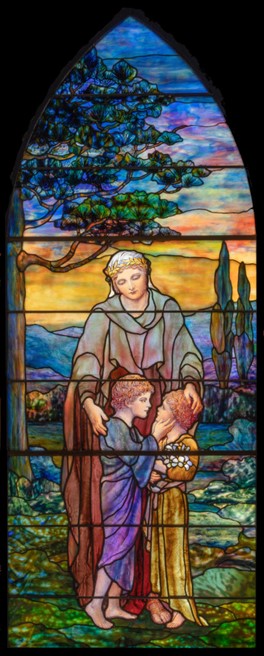 In this contagious spirit of giving, the “kiss of charity” has been passed down in the Nickerson Mansion since 1883 by the civic-minded stewards of this building: the Nickersons, the Fishers, the 100 prominent Chicagoans who saved the house in 1919, and the Museum’s founder Richard H. Driehaus. Through their unbreakable commitment to fuse the historical significance of a house with art and cultural enrichment, this space continuously offers experiences for the contemporary world to better understand the past and to inspire possibilities for the future.
Image left: Tiffany Studios, American (1902-1932), designed after Frederick Wilson (American, born Ireland, 1858-1932). Charity, 1925. Leaded and enameled glass. The Collection of Richard H. Driehaus, Chicago, 40112.a. Photography by Michael Tropea, 2018.
Image top: Left, Matilda Nickerson. Right, Jane Addams, Retrieved from http://loc.gov/pictures/resource/cph.3a13016/ on 12/10/2020
1 Nugent, Walter. “Demography.” Encyclopedia of Chicago History, http://www.encyclopedia.chicagohistory.org/pages/962.html
2 Fischer, Marilyn. "Addams on Cultural Pluralism, European Immigrants, and African Americans." The Pluralist 9, no. 3 (2014): 38-58.
3 Schneiderhan, Erik. "Pragmatism and Empirical Sociology: The Case of Jane Addams and Hull-House, 1889-1895." Theory and Society 40, no. 6 (2011): 589-617.
4 Lissak, Rivka. "Myth and Reality: The Pattern of Relationship between the Hull House Circle and the "New Immigrants" on Chicago's West Side, 1890-1919." Journal of American Ethnic History 2, no. 2 (1983): 21-50.
5 Fischer, Marilyn. "Addams on Cultural Pluralism, European Immigrants, and African Americans." The Pluralist 9, no. 3 (2014): 38-58.
6 Hautzinger, Daniel. "The Groundbreaking Women of Hull House." wttw.com (March 8, 2017).
7 Social Welfare History Project. "Hull House." Virginia Commonwealth University (December 18, 2018).
8 Lissak, Rivka. "Myth and Reality: The Pattern of Relationship between the Hull House Circle and the "New Immigrants" on Chicago's West Side, 1890-1919." Journal of American Ethnic History 2, no. 2 (1983): 21-50.
9 Polikoff, Barbara Garland. With One Bold Act : The Story of Jane Addams, p. 76, New York: Boswell Books, 1999.
10 Lissak, Rivka. "Myth and Reality: The Pattern of Relationship between the Hull House Circle and the "New Immigrants" on Chicago's West Side, 1890-1919." Journal of American Ethnic History 2, no. 2 (1983): 21-50.
11 Epstein, Dena J.., Polacheck, Hilda. I Came a Stranger: The Story of a Hull-House Girl. United States: University of Illinois Press, 1991.
12 Social Welfare History Project. "Kelly, Florence." Virginia Commonwealth University (June 16, 2020).
13 Hautzinger, Daniel. "The Groundbreaking Women of Hull House." wttw.com (March 8, 2017).