From Hand to Hearth: The Maher Gallery Fireplace Restoration
November 24, 2020
Contributed by Paul Neumann
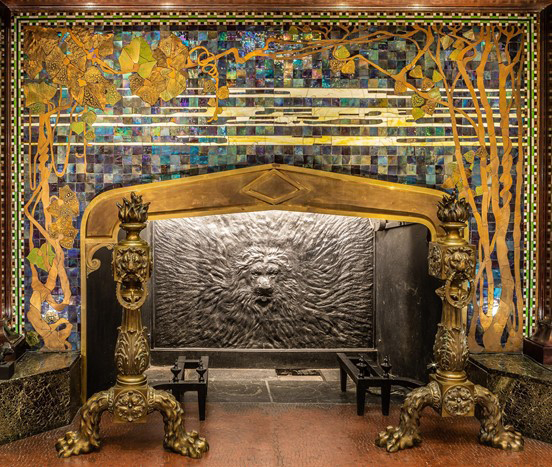
In 1900, the second owner of the Nickerson Mansion, Lucius George Fisher, commissioned architect George Washington Maher, to renovate the first-floor Gallery to include a large stained-glass dome and an imposing wood-burning fireplace. This fireplace features a stunning glass mosaic fire surround made with an iridescent, metallic luster, and opalescent glass attributed to the studio of Giannini & Hilgart.
Glass restorer Ettore Christopher (Chris) Botti of Botti Studio of Architectural Arts shares his thoughts and insights about restoring the historic glass mosaics at the Nickerson Mansion.
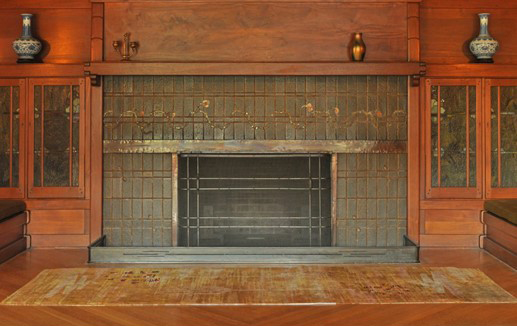
Botti Studio of Architectural Arts is a nationally recognized company headquartered in Evanston, Illinois with additional offices around the country. Botti Studio, a family-run business, has been in continuous operation in the United States for 145 years. One of their most recent projects was the re-creation of a stained-glass laylight ceiling in the famous Palm Court of the Plaza Hotel in New York City.
The Botti family and their traditions of working with glass go as far back as the 16th-century in Florence, Italy. The family business, which focused on ecclesiastical work (stained glass, mosaics, and paintings), moved to southern Italy, and eventually became part of the American immigrant story by coming to the United States.
Vincent J. Cannato, writing for HUMANITIES - The Magazine of the National Endowment for the Arts wrote about immigration and said, “For Italians (their strategy for success)... rested upon two pillars: work and family... Their work provided them a small economic foothold in American society and allowed them to provide for their families, which stood at the core of Italian-American life.”
In 1860, Chris’s great-great-grandfather Raffael came to America from Naples. Then in 1890, he had a son Ettore Botti, who Chris is named after. Ettore brought over Chris’s grandmother Philomena from Agropoli, Italy in 1920. She was nine months pregnant with Chris’s father. Chris said that ”they landed in Ellis Island and the customs agents had the men in the family disembark first with the family paperwork.” Philomena was still on the ship, “That’s when he heard my grandmother yell to him that she was having the baby. He waved to her to come down off of the ramp of the ship and have the baby on American soil which she did, and they named my father ‘Italo’ which means “Italian American.”
During World War II, Italo Botti enlisted in the U.S. Army and landed in Normandy with the first wave. He received two Bronze Star Medals and two Purple Hearts, having fought his way through the Battle of the Bulge, crossed the Rhine, and was one of the first American troops to make it to Berlin. He stayed in Germany a year after the end of the war helping the occupation forces locate and neutralize land mines and disarm enemy artillery and tanks.
When Italo returned to the States, he enrolled at The Art Students League of New York where he met his future wife Ethlyn Panzironi, the only woman in the class. Other students in the class included LeRoy Neiman and Nicola Simbari, while Frank Vincent DuMond was their famous instructor, who was part of the Ashcan School of Art. Italo was the lead artist in the class. Chris’s future parents soon realized that each of their families had a background with ecclesiastical art studios, they fell in love and got married. Chris’s mother, Ethlyn was a noted fashion illustrator and was involved in the design of many of the Botti Studio’s projects.
At a young age, Chris helped his family with their commission of the lobby of the Encyclopædia Britannica headquarters on 42nd street in New York City. This project was headed by Chris’s maternal grandfather Richard Panzironi and his father Italo while Chris assisted at the studio. Chris remembered, “I mixed the gold they applied, and I loaded and unloaded the kiln, the other craftspeople cut the glass and, adhered in plaster, set the machine textured glass and installed the panels on the lobby wall around the elevators.”
Instructed by Chris’ great grandfather, Ilario Panzironi, and grandfather, Ricardo Panzironi, Chris recalled that when he was, “...working at my grandfather’s studio in Manhattan, at the Panzironi studios, I was taught the technique (a trade secret) of firing gold onto glass. The gold would separate when fired in the kiln to give it an organic look of bark on a tree or vine and recreate the leaves with a vein...”
Chris worked in Manhattan at the Botti studio as well as the Panzironi studios which later merged in 1964. After Chris’s grandparents on both sides died, they combined the studios under the name: Botti Studios.
A major contract with Cardinal John Cody to work on Catholic church properties in Chicago was the catalyst for the family’s move to Evanston, Illinois when Chris was only 10 years old. Through the decades, the studio worked on many historically significant projects including the restoration and conservation of twelve cathedrals, hundreds of churches and synagogues including Saint Patrick’s Cathedral in New York, and two Tiffany domes including the dome at the Art Institute of Chicago and the largest Tiffany dome in the world located at the Chicago Cultural Center. Botti Studio’s work continues with the Driehaus Museum through its exhibitions and collection of art glass, most recently with the conservation of the ecclesiastical windows on display in the Driehaus Museum’s 2019-20 exhibition Eternal Light: The Sacred Stained-Glass Windows of Louis Comfort Tiffany.
When asked to restore the fire surround at the Nickerson Mansion, Chris remarked that “It had been a long time, some fifty years, that I had used this technique,” and it took him about a week of trial and error to practice recreating it. He said that he wanted “to get it just right for Mr. Driehaus.”
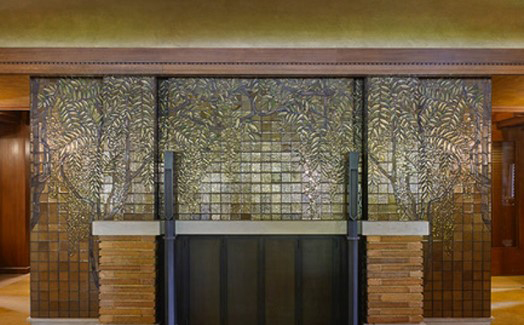
Several years ago, Frank Lloyd Wright's Darwin Martin House's Executive Director, Mary Roberts, led an architectural trip from Buffalo, New York to Chicago and visited the Nickerson Mansion. While touring the house, Mary had excitedly identified that the Maher fireplace was by Giannini & Hilgart, exclaiming to her group, "That's our fireplace!" Mary and the Martin House restoration architects had been searching for five years for a company able to restore their signature fireplace designed by Giannini & Hilgart, who had often collaborated with Wright. This chance visit led Mary to speak with a Driehaus Museum curator who then introduced her to Chris and his design studio.
When the Martin House project was commissioned Chris then had the special gold technique and practice from the experience working on the Nickerson Mansion to start their restoration. After a three-year project, which coincided with the Martin House’s twenty-year restoration efforts, the imposing and fabulous four-sided fireplace at the Martin House was beautifully and painstakingly restored. The fireplace was fully recreated by Botti studios with only a dozen or so original pieces remaining and which were reincorporated.
Like the Nickerson Mansion’s fire surround, the specific gold technique of fusing gold into glass complimented the geometric abstraction known with Wright's designs. Mary also recounted that workers from Giannini & Hilgart and Botti studios traded workers for various commissions which is how the gold technique was passed on.
Through trial and success, Chris’s talents used to restore both the Nickerson Mansion and Martin House’s fireplaces would not have been possible without the dedication and expertise found within this specialized craft.
In the 1860s, as the Botti family relocated their business to America, Samuel Nickerson was running a family distillery business in Chicago that aided the Union Army during the American Civil War. This business was the foundation for the Nickerson fortune which eventually built an art collection and rebuilt their home lost in the Great Fire. Over a hundred years before the work of the Bottis and the Nickersons would intersect through a preservation project for the Driehaus Museum, these two separate families were working to contribute to the United States - through tragedies of war and fire, through passions for art, and through achievement that comes with personal commitment and professional investment.
The Botti family story of entrepreneurship and immigration is an American tale of hard work, perseverance, and risk-taking that became embedded in the fabric of a young America. Ethlyn Panzironi Botti’s motto was to repair “everything but broken hearts.” Botti's story continues to be an important part of the restoration and lasting beauty of landmark spaces that nourish the minds and hearts of the public today. The Nickerson Mansion is an American manifestation that has showcased the talents of craftspeople, designers, restorers, and conservationists for over 140 years.
This blog is dedicated to the memory of Ethlyn Panzironi Botti (1922 -2020).
We would like to graciously thank Chris Botti and Megan Brady of Botti Studio of Architectural Arts, Mary Roberts, Executive Director for Frank Lloyd Wright’s Darwin Martin House, and Ted Ellison for their assistance in making this blog possible.