Male Attitudes Toward Women in Late 19th Century Art: Eugène Grasset's Dix Estampes Décoratives
May 11, 2022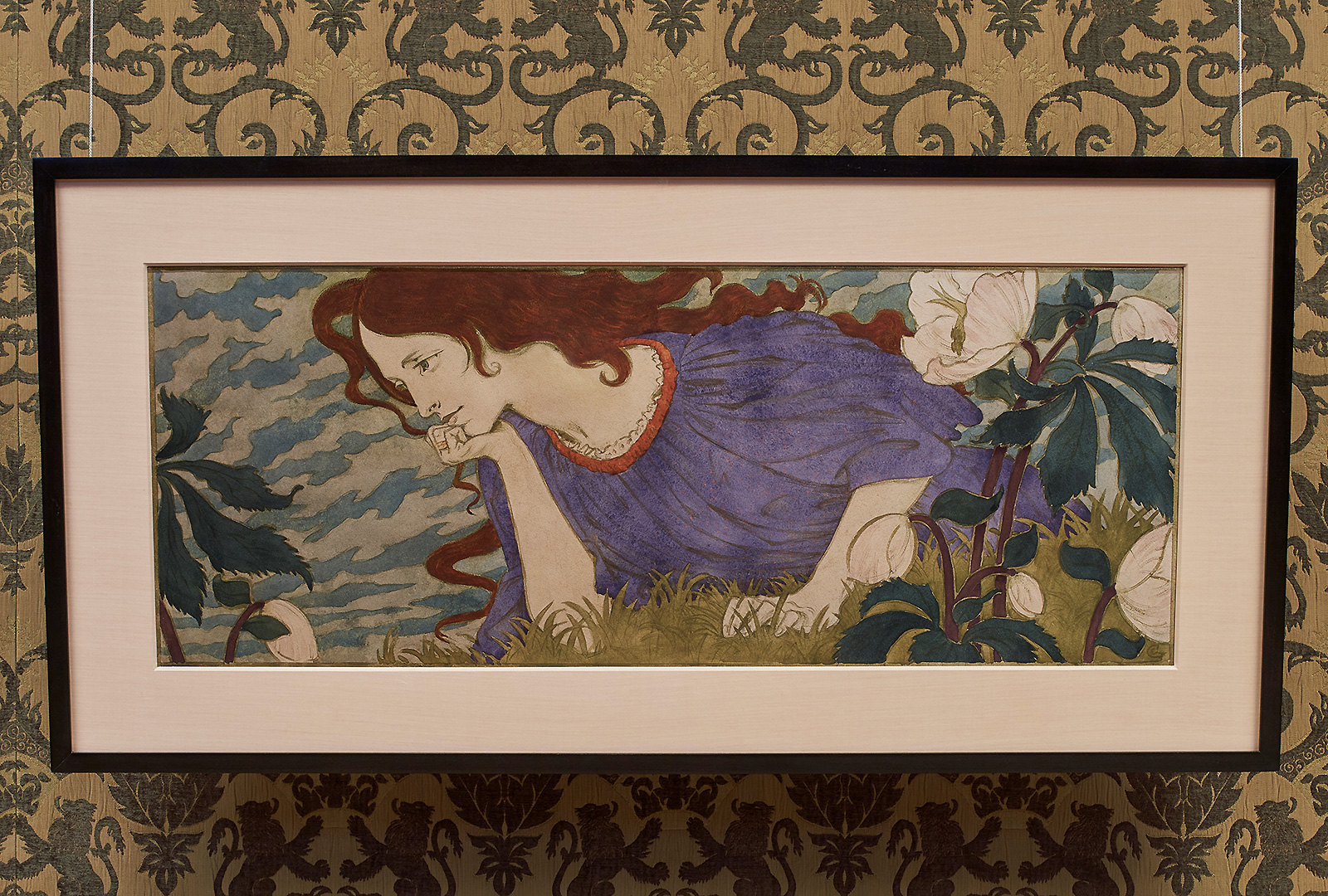
As part of the 2022 exhibition, Theodora Allen: Saturnine, we have brought together several iconic works from the Richard H. Driehaus Collection that correspond to and complement Allen’s ideas about nature and myth as they have resonated over the centuries. The late 19th century and the Gilded Age in particular was a period where nature was a supreme source of inspiration.
In Anxiété [Anxiety], the world tilts on its axis as a dark-haired woman lies stretched out on the grass. Early spring flowers called hellebores, or Christmas roses, surround her while jagged clouds fill the sky.
In choosing the hellebore, Grasset followed one of the many books published in the nineteenth century on the “language of flowers” to better communicate his message. Hellebores are known for their association with anxiety, and its medicinal power to soothe. Flower symbolism would have been quite familiar to most viewers, some of whom employed them as a secret code in messages to a beloved. I
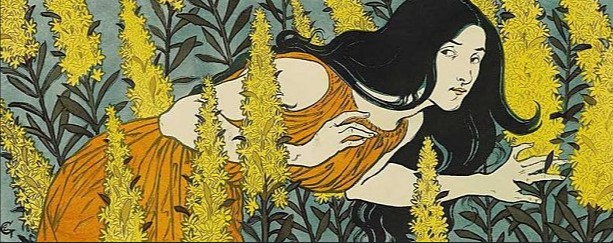
Other images in Grasset’s series explore a similarly dramatic or extreme states of being, with titles such as Jealousy, Coldness,Danger, Extravagance, Temptation, or Worry, as seen below.
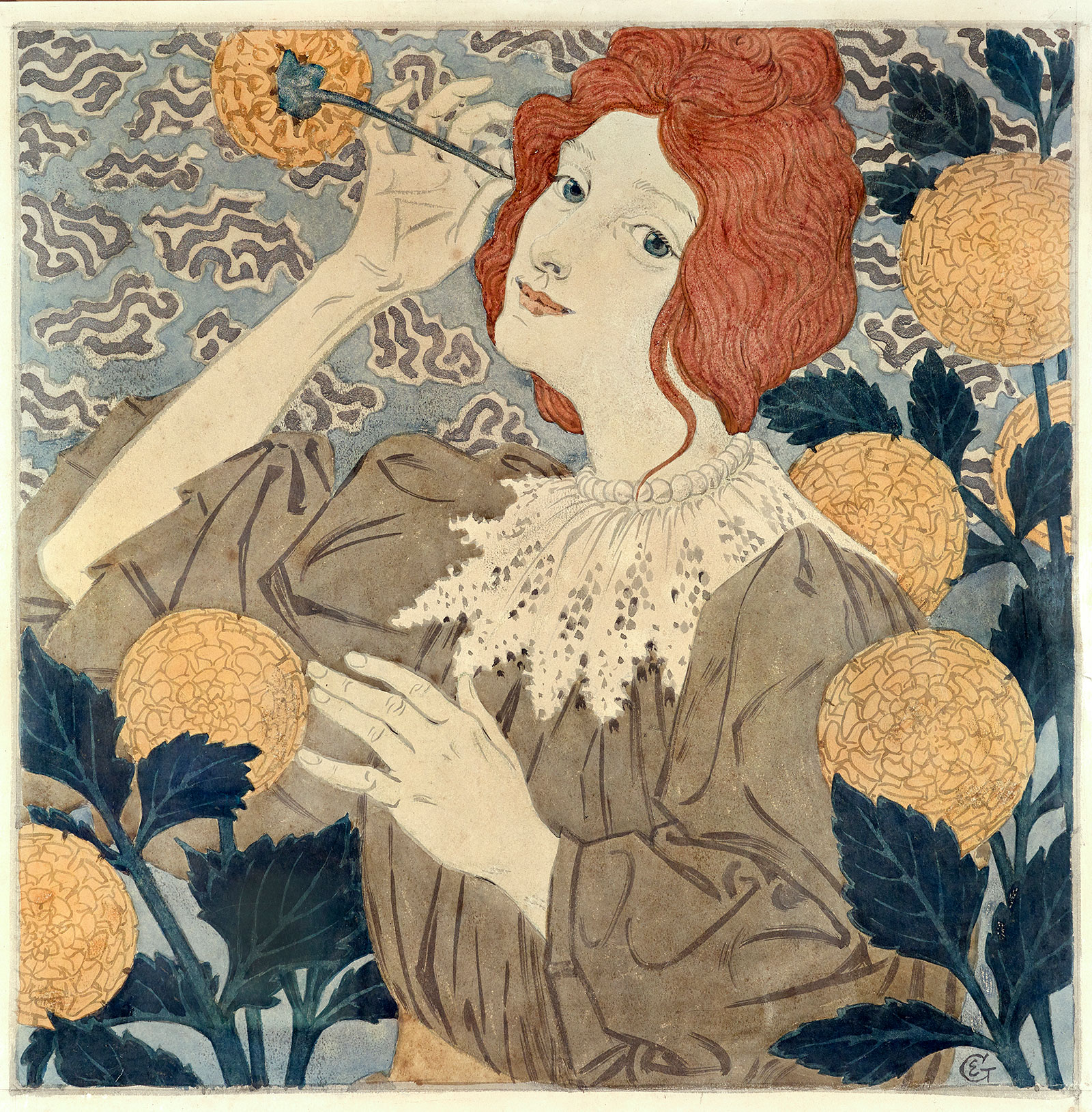
Coquetterie [Coquetry or Flirtation] presents a woman who has tucked a brilliant bloom behind her ear. Her direct gaze invites the viewer to look back, and perhaps respond to her bold invitation.
But one might reasonably ask: Coldness? Fear? Anxiety? Flirtation? How could these sum up the inner life of a woman? Where is joy? Fearlessness? Warmth, kindness, leadership, strength, resourcefulness, creativity?
However beautiful these prints, with their vivid coloring, delicate outlines and sumptuously stylized motifs, Grasset's view of female feelings can seem, to a contemporary eye, too narrowly considered, and far too negative to encompass the fullness of women’s lives. But let’s look a little closer to understand why, at the end of the nineteenth century, Grasset occupied himself with this subject as a man and as an artist.
To do this, we must begin with the now-discredited concept of hysteria. II
A year before Swiss-born Grasset moved to France in 1871, a neurologist named Jean Martin Charcot began to study a uniquely female affliction called hysteria. A book of photographs, Iconographie Photographique de la Salpêtriére (1875-1880), showed women in various states of hysteria being treated by hypnosis, Charcot’s favored method.
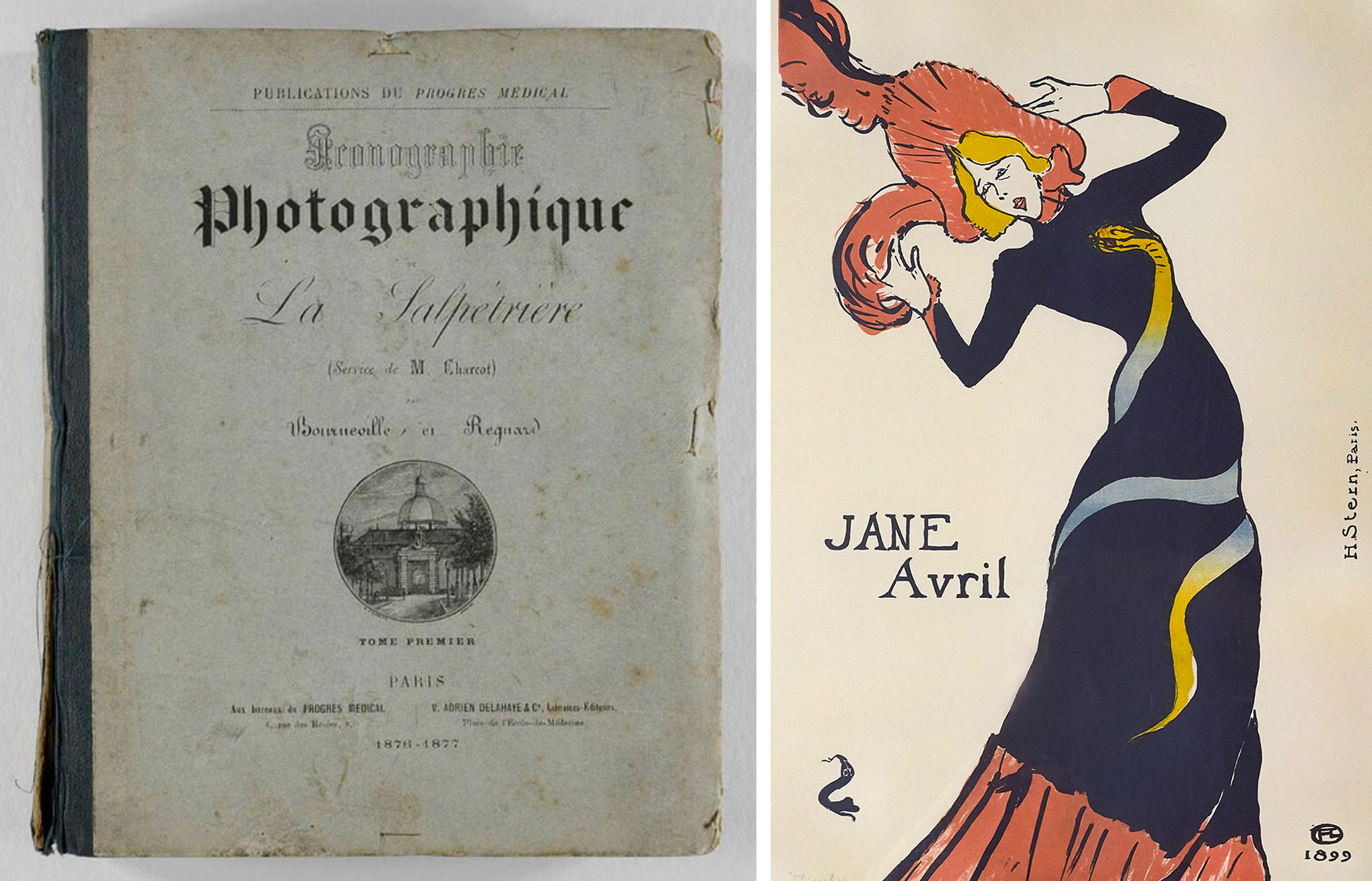
Jane Avril, the famous dancer at the Moulin Rouge, and immortalized in posters by Henri de Toulouse-Lautrec, was one of Charcot’s more famous patients. III Charcot believed that hysteria, which presented in the form of seizures, contortions, a range of highly charged emotions, and delirium, must be rooted in the nervous system. His studies gained considerable fame in his own time, yet medicine was a profession that like many, were dominated by men who misunderstood and marginalized women. Male doctors used hysteria as the explanation “for everything that they found mysterious or unmanageable in women.” IV
But Charcot wasn’t the first to explore the idea of a disorder affecting only women; this idea goes as far back as the ancient Egyptians in the second millennium BC. The word “hysteria,” in fact, originates in the ancient Greek word for uterus.
Setting aside for the moment those with true mental disturbances, scholars now believe that a “hysteria” diagnosis unfairly masked the deep frustration and unhappiness of many women who refused to conform to the strictures of late Victorian society and had no legal standing to support their needs. Their protest only brought more despair upon themselves.
By 1897, when Grasset produced his series of images, women were actively entering into the public sphere. They took up the bicycle, a new symbol of freedom, and began to walk together in public, unaccompanied by men.
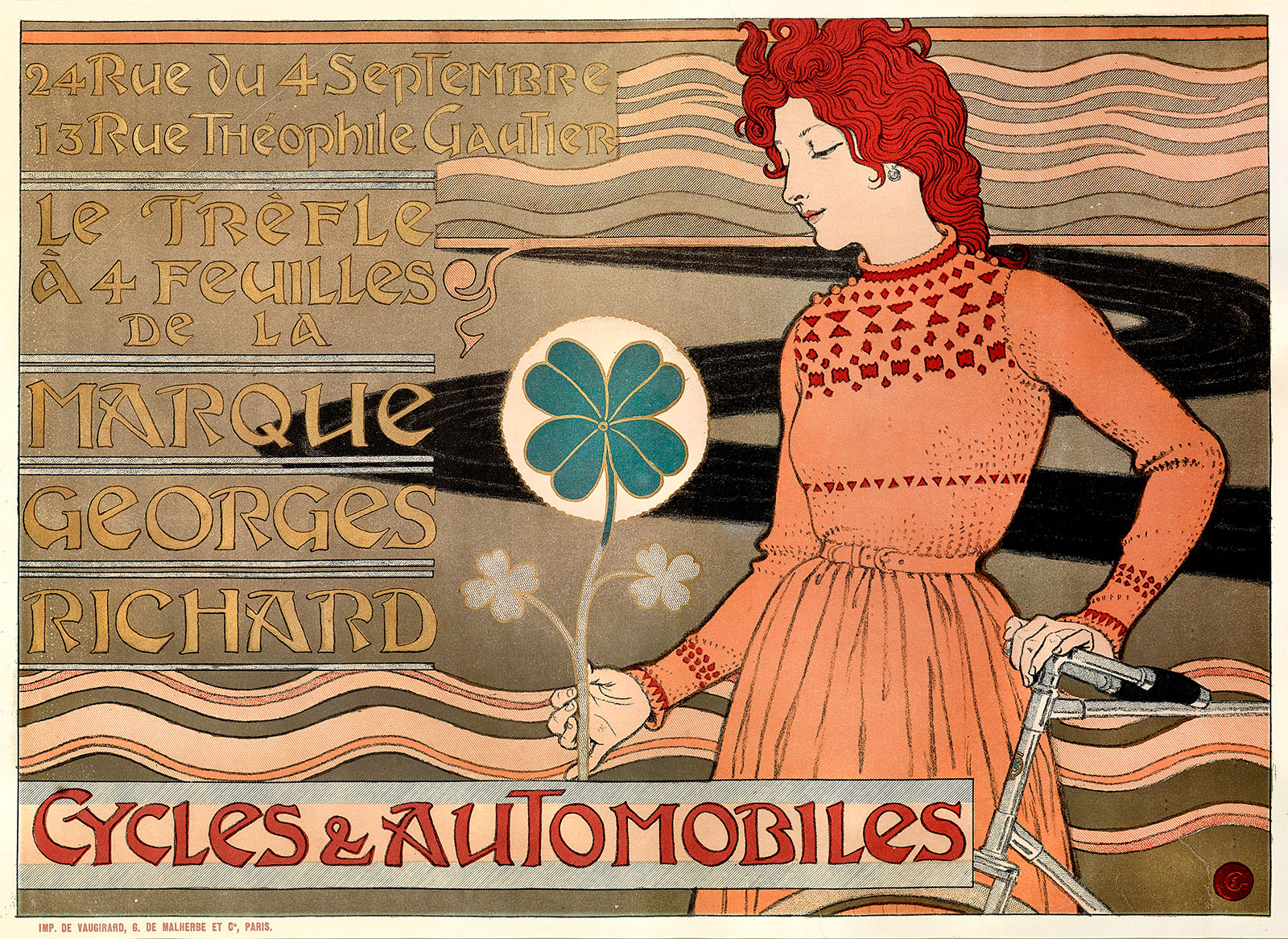
Despite these encouraging signs, women who stepped out of their assigned roles as mother and wife posed a challenge to traditional, male-dominated society in France and elsewhere. It is possible that Grasset expressed his own concerns with subject in this series.
While we don’t know what Grasset thought of women, it is clear that his early posters of the early 1890s, such as the one on the left, depict them in a virginal manner, pensive and delicate.

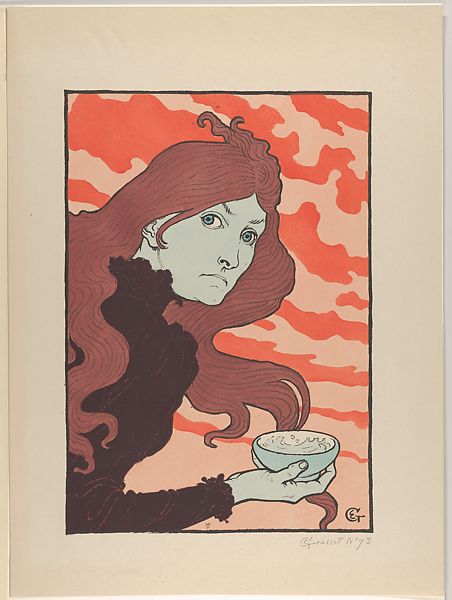
Sheet: 20 5/8 × 15 1/4 in. Rogers Fund, 1922, Metropolitan Museum of Art.
He seems to have changed his point of view by the mid-1890s with two shocking prints of women engaged in irrational and self-destructive or behavior. In La Vitrioleuse [The Acid Thrower] of 1894, the work on the right, the woman is depicted agitating a cup of sulfuric acid in the moments before she attacks an unsuspecting rival.
Such aberrant behavior was considered another manifestation of the public fascination with female hysteria.
Just as troubling was the Morphinomane, 1897 [Morphine Addict] which features a young woman in a rumpled chemise – perhaps inferring that she is a prostitute - injecting herself with the drug; an ampule sits on the table.
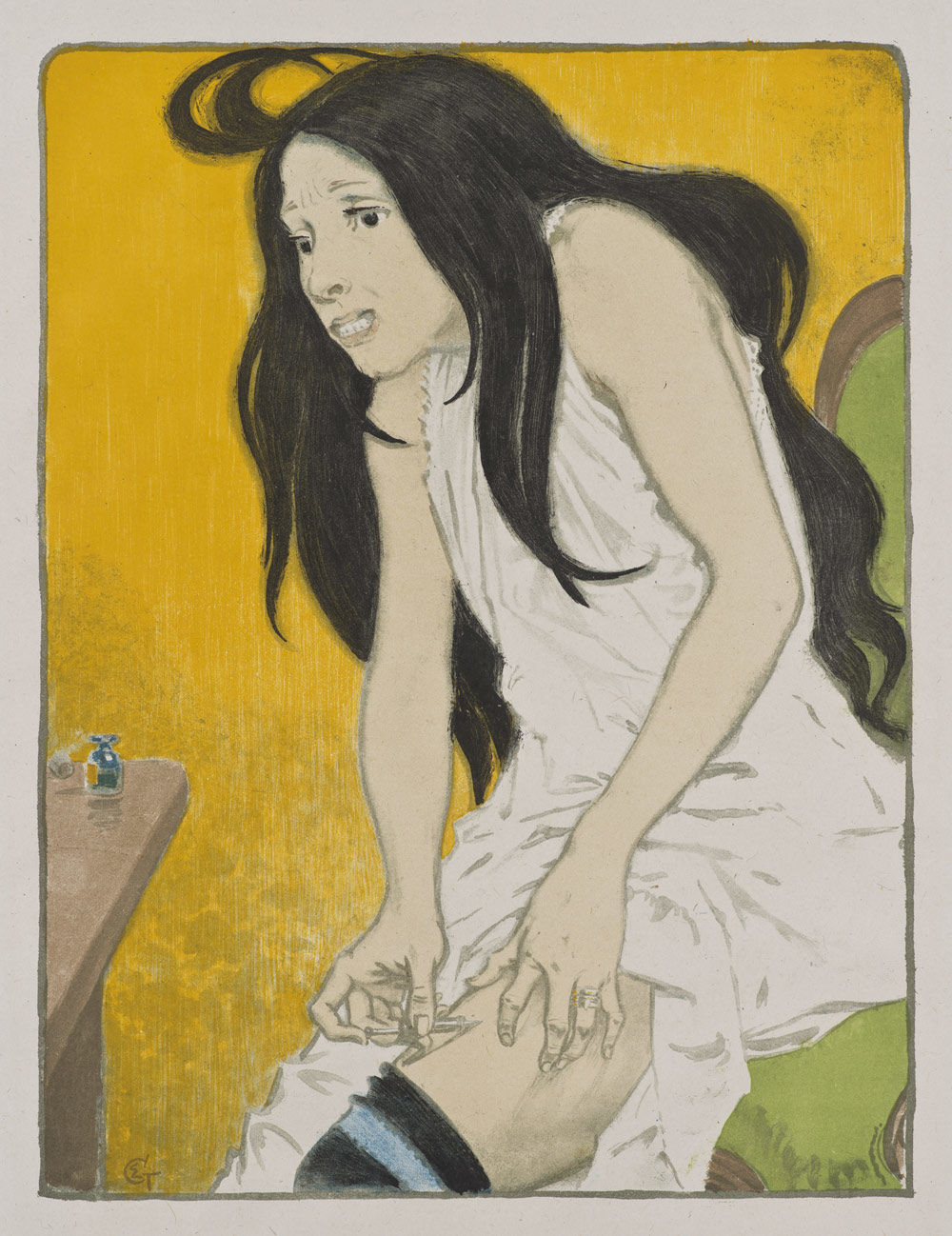
The graphic inclusion of the syringe and bottle adds to the air of desperation. Women of all classes were known to take morphine, including those facing harsh economic realities. The image fueled the negative depictions of women who had lost control of their senses.
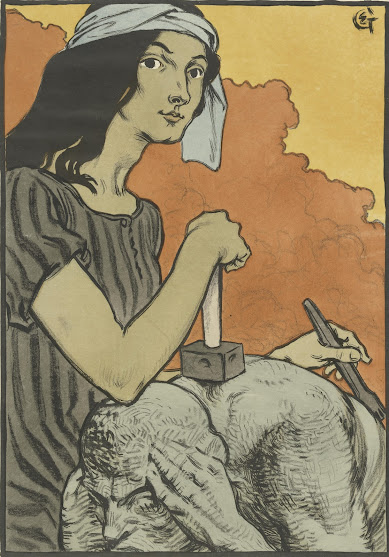
Why did Grasset produce these disturbing images? We do not know. However, he seems to have enjoyed a bit of fun at women’s expense in La Sculpture, a poster for an exhibition of work by the French sculptor Alexandre Falguière. For this occasion, he featured a confident young woman who wields a hammer and chisel upon the figure of a crouching man.
Undercutting the woman’s strong position is the sculpture in the foreground; the man holds his temples and squeezes his eyes in agony. The message remains open to interpretation.
It is likely that Grasset reacted as a typical man of turn-of-the-century Paris to a dual phenomenon: women acting upon their own agency versus being restrained in their desires and considered “hysterical” by the medical profession. The situation no doubt prompted conflicted feelings in men who felt threatened by these developments. Such thinking could have prompted a move from one extreme to the other – from the early idealized images of women to those he considered improper or perhaps typical of female weakness.
Born in Switzerland in 1850, Eugène Grasset studied and practiced many art forms—from painting to architecture, theatre decoration, textiles, children’s stories, wallpaper, furniture, lighting, book covers, and lithography. He was a devotee of the British Arts and Crafts movement, which embraced all forms of making as art in its own right. The black outlines in his drawings and posters are reminiscent of stained-glass windows, and sweeping, simple gowns worn by women in his works hearken back to the British Pre-Raphaelite painters. How he was moved to develop these images of women in various unflattering poses points to the time he lived in as a man and as an artist, when women were beginning to contest for their own space in the world.
Bibliography:
Bonduelle, Michel and Gelfand, Toby. “Hysteria Behind the Scenes: Jane Avril at the Salpêtrière,” Journal of the History of the Neurosciences, 8:1, 35-42, 1999.
Falino, Jeannine, L’Affichomania: The Passion for French Posters audio tour, The Richard H. Driehaus Museum / Acoustiguide, 2017.
Hopper, Allan H. and Burrell, Brian, "In Search of Hysteria: The Man Who Thought He Could Define Madness,” Literary Hub, September 20, 2019.
Jacoby, Kristie. “Hellebores: Fact and Folklore.” Washington State University, February 3, 2017.
McVean, Ada B.Sc. “The History of Hysteria,” McGill University Office of Science and Society, July 31, 2018.
Occasional Papers from the RHS Lindley Library. Volume 10 (April 2013). The Victorian Language of Flowers.
Schiff, Joel L., “Hysteria and Victorian Women in Art,” March 4, 2021.
Tasca C, Rapetti M, Carta MG, Fadda B. “Women and Hysteria in the History of Mental Health,” Clinical Practice & Epidemiology in Mental Health. 2012; 8:110-119.
Uzanne, Octave. “Eugene Grasset.” The Studio, vol. four, 1894.
I https://www.rhs.org.uk/about-the-rhs/pdfs/publications/lindley-library-occasional-papers/volume-ten.pdf
II https://www.mcgill.ca/oss/article/history-quackery/history-hysteria
III https://pubmed.ncbi.nlm.nih.gov/11624134/
IV https://www.mcgill.ca/oss/article/history-quackery/history-hysteria.