A Tale of Today: Up From the Ashes - Pullman Porters and the Great Migration
February 18, 2021
Contributed by Ryan McKibben
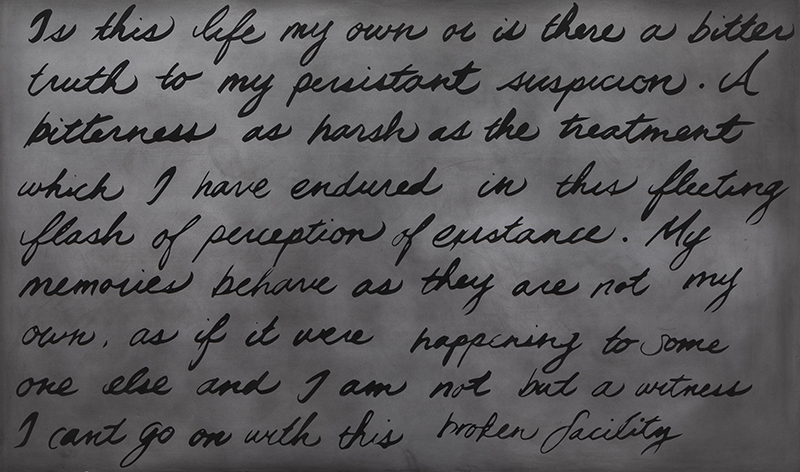
As a part of the Driehaus Museum’s ongoing mission to expand upon the shaping of Chicago during the Gilded Age through our A Tale of Today: Up From the Ashes series, this Black History Month we look to the Great Migration, the Chicago Defender, the Pullman porters, and the roots of Chicago’s Black working class. In our current contemporary exhibition, A Tale of Today: Nate Young and Mika Horibuchi, Nate Young reveals aspects of the Great Migration. His installations connect back to his family history and the original interior design of the Nickerson Mansion, both of which served as inspiration for new art that relates to the story of his great-grandfather. Young’s great-grandfather, like many African-Americans who migrated, took a hopeful journey from the rural South to the urban North. For him, it was also one of peril, adventure, trauma, and exhaustion as evidenced by a suicide note left for his family in his final days.
While the Great Migration was difficult, promising job opportunities in the North that could change the trajectory of life for African-Americans actively looking for ways out of the segregated South made it worthwhile. Of the opportunities offered in the North, few were more prestigious than those found aboard the Pullman Palace Cars. George Pullman hired almost entirely African-American workers, many of whom were former slaves, for his luxury railcars; these workers would come to be known as the Pullman porters. The Pullman Palace Cars exemplified the Gilded Age by prioritizing luxury, comfort, and aesthetic excellence. They housed a black walnut interior, thick carpeting, plush upholstery, velvet curtains, elegant chandeliers, and ceiling murals. The porters’ excellence in service mirrored the beautiful interiors of the railcars and became the epitome of first-class railroad service in Chicago and across the nation.1 The porters presented a quiet dignity and a gentlemanly demeanor. They were the pride of their communities and heralded as role models by those in search of a respectable path towards upward mobility and access to greater freedom.2 It beat the much less pleasant and far more dangerous alternatives such as work in steel factories and meatpacking houses. For a meager wage and tips, a Pullman porter became the loyal personal assistant (and sometimes confidant) hired to cater to first-class railroad passengers traveling on George Pullman’s exclusive sleeping cars. On the job, they were all expected to answer to the name “George,” but even though the job was not always dignified, it remained a tenet of the Pullman porter to always act with dignity.

The Great Migration emerged in the wake of Reconstruction in the late 1800s as the dream of landownership and freedom for African-Americans in the South collapsed. Jim Crow laws constricted everyday life, and the Ku Klux Klan, along with other radical groups, continued perpetrating acts of intimidation and violence including lynching. Of the approximately 7 million African-Americans that left, about 500,000 migrated to Chicago in just three years between 1916 and 1919.34 Most left by train, boat, or bus. Others used automobiles and horse-drawn carriages.5 Routes followed three main paths: the first was up the East Coast from Florida, Georgia, the Carolinas and Virginia to Washington, D.C., Baltimore, Philadelphia, New York and Boston; the second, up the country’s central spine, from Alabama, Mississippi, Tennessee and Arkansas to St. Louis, Chicago, Cleveland, Detroit and the entire Midwest; the third, from Louisiana and Texas to California and other Western states.
The exodus of African-Americans meant the loss of cheap labor for the South. Southern authorities tried to stop it by detaining African-Americans at the railroad platforms on grounds of “vagrancy” until they missed their train or by simply confiscating and tearing up their tickets. Those who were able to board trains were packed into “Jim Crow cars,” segregated cars with no comfort or amenities. For example, since African-Americans were not allowed into the dining car, riders in Jim Crow cars had to find other ways to get food during their trip. The challenges of the journey were exacerbated by the absence of family and friends left behind and the reality that the familiar trappings of racial discrimination could not be fully left behind.6
Between 1910 and 1920, in concert with increased need for labor due to the Great War, a successful effort led by Chicago’s Black community helped fuel the Great Migration. During this period, the percentage of African-Americans residing in Chicago increased by 148 percent.7 This was in large part due to a partnership between the Pullman porters and the Chicago Defender, a publication established by entrepreneur Robert S. Abbott in 1905 that served as advocate and support for what it called “the race.” The Defender opened a window to opportunities in the North for African-Americans while exposing their continued struggles in the South. Its classified ads offered jobs, housing, and transportation out of the Jim Crow South that no one else dared to. Southern towns dependent on cheap Black labor attempted to ban and regulate the distribution of the Defender. Distributors risked their lives to smuggle the paper into these towns and successfully circulated issues that made their way into common gathering places such as barbershops and churches to be read aloud in order to reach as many people as possible.8 Jobs advertised through the Defender ranged from restaurant staff to musicians to domestic services.9
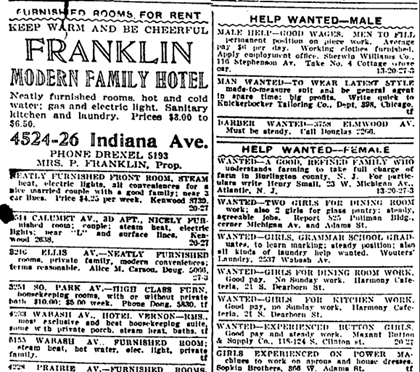
An advertisement from the December 27, 1919 issue of the Chicago Defender
Black southerners found hope for the life they dreamed of through the pages of the Defender, and many sent notes back to the paper to introduce themselves and their job qualifications. A seventeen-year-old girl from Texas who had dropped out of school due to lack of money wrote, “I am a reader of the Chicago Defender I think it is one of the Most Wonderful Papers of our race printed. Sirs I am writeing to see if You all will please get me a job… Sir I will thank you all with all my heart. [sic]”10
A man whose family was in dire straits wrote:
“I have been reading the Chicago defender and seeing so many advertisements about the work in the north I thought to write you concerning my condition. I am working hard in the south and can hardly earn a living. I have a wife and one child and can hardly feed them. I thought to write and ask you for some information concerning how to get a pass for myself and family. I dont want to leave my family behind as I cant hardly make a living for them right here with them and I know they would fare hard if I would leave them. [sic]”11
These letters, written by young and old alike, carried the same sense of urgency, humility, gratitude, and desperation.
African-Americans who found jobs as Pullman porters quickly established themselves as part of the national consciousness of the Black community in the North, but they also played an important role in uplifting the South. While it was newsboys who increased circulation of the Chicago Defender in Chicago, it was the Pullman porters working on south-bound trains, grateful to the paper that guided them North, who smuggled the paper into circulation in those Southern towns.12 They spread the word and together, the Defender and the Pullman porters pulled more African-Americans North through the promise of economic and social stability.

Through stories collected from descendents of the Pullman porters, Dr. Lyn Hughes, founder of the National A. Philip Randolph Pullman Porter Museum in Chicago, describes the five values that defined the porters’ craft: self-pride, belief in unity, a self-imposed standard of excellence, dedication to the Union, and commitment to family.13 The child of one Pullman porter recounts that her father “taught [my siblings and I] how to negotiate through life’s adversities and to meet each day in a positive manner.” Another child of a Pullman porter described how her father’s work affected her: “The tips that he earned as a waiter was the real money that kept his family afloat during the Depression. I keep that in mind when eating out, to this day.”14 This was the unfortunate truth of how wages were earned for many Black workers, especially the porters: they had to live off of the tips they received.15
Despite the great effort they put into ensuring the high standard of the Pullman Palace Cars was met, the porters had to endure long hours at minimal pay. For example, they had to put in either 400 hours or 11,000 miles every month in order to receive full pay.16 The necessity to unionize was clear, and in 1925 the Brotherhood of Sleeping Car Porters (BSCP) attempted to establish itself in Chicago with A. Philip Randolph at its head.
The men of the BSCP were not the only ones fighting for the union. Women were invaluable to the organization and mobilization of this movement within the Black community. The wives of the Pullman porters worked both as maids aboard the Pullman railcars and as community organizers as a part of the Brotherhood’s Ladies’ Auxiliary. These women collected union dues and organized meetings among various other tasks. Just as the Brotherhood took pride in its accomplishments, the Women’s Auxiliary was able to proudly declare itself "members of the first international labor organization of Black women in the world."17

After a decade of struggle, a contract between the BSCP and the Pullman Company was signed on August 25, 1937. The minimum monthly wages increased for porters from $77.50 to $89.50 and for maids from $75.00 to $87.00. Porters were provided a guaranteed 240-hour month with overtime pay after 260 hours.18 This was a landmark achievement for both the porters and for the African-American community. Never before had a Black union organized in such a way as the BSCP and successfully negotiated for better pay. With the establishment of the union, the Pullman porter found a new way to inspire African-Americans across the nation. 19 The Brotherhood stood as a definitive counterpoint to the argument that Black workers could not powerfully organize, and helped lay the groundwork for the development of the Civil Rights Movement. Furthermore, they made the Black community relevant to the American labor movement of the 20th century.
The success of the Pullman porters during the Great Migration became an integral part of the history of Chicago and its formation of a new Black middle class through a belief in the dignity of labor both inside and outside the home, focus on education, and commitment to family and community. Their legacy would be one of excellence, resilience, and industriousness not only aboard the Pullman railcars, but also in their lives as the values they held were imparted to their children and grandchildren. As we celebrate Black History Month through A Tale of Today: Up From the Ashes, we honor the Pullman porters and the Chicago Defender.
1 The A. Philip Randolph Pullman Porter Museum, 2002, aprpullmanportermuseum.org/.
2 Reed, Christopher R.. “Chapter 3.” An Anthology of Respect: the Pullman Porters National Historic Registry of African-American Railroad Employees, by Lyn Hughes, Hughes Peterson Pub., 2009, pp. 21.
3Grossman, James. “Chicago and the Great Migration.” Illinois Periodicals Online, 1996, www.lib.niu.edu/1996/iht329633.html.
4Grossman, James. “Great Migration.” Encyclopedia of Chicago, 2005, encyclopedia.chicagohistory.org/pages/545.html.
5 History.com Editors. “The Great Migration.” History.com, A&E Television Networks, 4 Mar. 2010, www.history.com/topics/black-history/great-migration#section_2.
6 Wilkerson, Isabel. “The Long-Lasting Legacy of the Great Migration.” Smithsonian.com, Smithsonian Institution, 1 Sept. 2016. www.smithsonianmag.com/history/long-lasting-legacy-great-migration-180960118/.
7 History.com Editors. “The Great Migration.” History.com, A&E Television Networks, 4 Mar. 2010, www.history.com/topics/black-history/great-migration.
8 “The Chicago Defender.” PBS, Public Broadcasting Service, www.pbs.org/blackpress/news_bios/defender.html.
9 "Classified Ad 1 -- no Title." The Chicago Defender (Big Weekend Edition) (1905-1966), Nov 29, 1919.
10 Journal of Negro History, Vol. IV, 1919, pp. 417, 302, 317, 327, 307, 59.
11 Journal of Negro History, Vol. IV, 1919, pp. 417, 302, 317, 327, 307, 59.
12 Roi Ottley, The Lonely Warrior, (Chicago: Henry Regnery Company, 1955).
13 Hughes, Lyn. “Chapter 2.” An Anthology of Respect: the Pullman Porters National Historic Registry of African-American Railroad Employees, by Lyn Hughes, Hughes Peterson Pub., 2009, pp. 7-13.
14 “Chapter 2,” 11-12.
15 Garsd, Jasmine. “How the End of Slavery Led to Two Different Minimum Wages.” Marketplace, 10 Feb. 2021, www.marketplace.org/2021/02/09/how-end-slavery-two-minimum-wages/.
16The A. Philip Randolph Pullman Porter Museum, 2002, aprpullmanportermuseum.org/.
17 Chateauvert, Melinda. "Marching Together: Women of the Brotherhood of Sleeping Car Porters." NWSA Journal 2, no. 4 (1990): 687-89. Accessed January 22, 2021. http://www.jstor.org/stable/4316092.
18 Valien, Preston. "The Brotherhood of Sleeping Car Porters." Phylon (1940-1956) 1, no. 3 (1940): 224-38. Accessed January 22, 2021. doi:10.2307/271990. 231-2
19 Tompkins-Bates, 31-51.