Ragtime: A Great American Innovation
June 15, 2022June 2022 marks the 14th birthday of the Driehaus Museum, and on June 25th the Museum will host its first public program in the John B. Murphy Memorial Auditorium, the adjacent space recently added to the Museum’s blueprint. Chicago ragtime composer and pianist Reginald R. Robinson will perform a program of ragtime compositions, followed by a screening of the silent Charlie Chaplin film, The Rink, with live piano accompaniment. Robinson is a steward of the ragtime tradition, interpreting classic ragtime compositions as well as composing his own. In 2004 he was awarded the rare and distinguished John D. & Catherine T. MacArthur Award for his innovative ragtime piano works and music research.
This post is contributed by Patrick Donley, music advisor to the Driehaus Museum. Donley explores the context of ragtime’s evolution in American culture, and why it is such a distinctly American musical form that is counted amongst the vast innovations that shaped our country today.
The year is 1894 in Sedalia, Missouri. The streets buzz with activity as music emanates from the many saloons and sporting houses. A feeling of amusement and spontaneity is in the air. The joyful and rhythmic melodies billowing from the pianos are the early sounds of ragtime, the grassroots music that was new and quickly developing throughout the nation.
Ragtime’s history is an important part of the social history of the United States. It arose through the creative expressions of African Americans in the late 19th century and evolved to take on unique forms throughout the early 20th century. The music developed in gambling houses, pool halls, saloons, and brothels in a young America where industry was booming, and merriment prevailed. Many of these places enjoyed music night after night with just a single pianist.
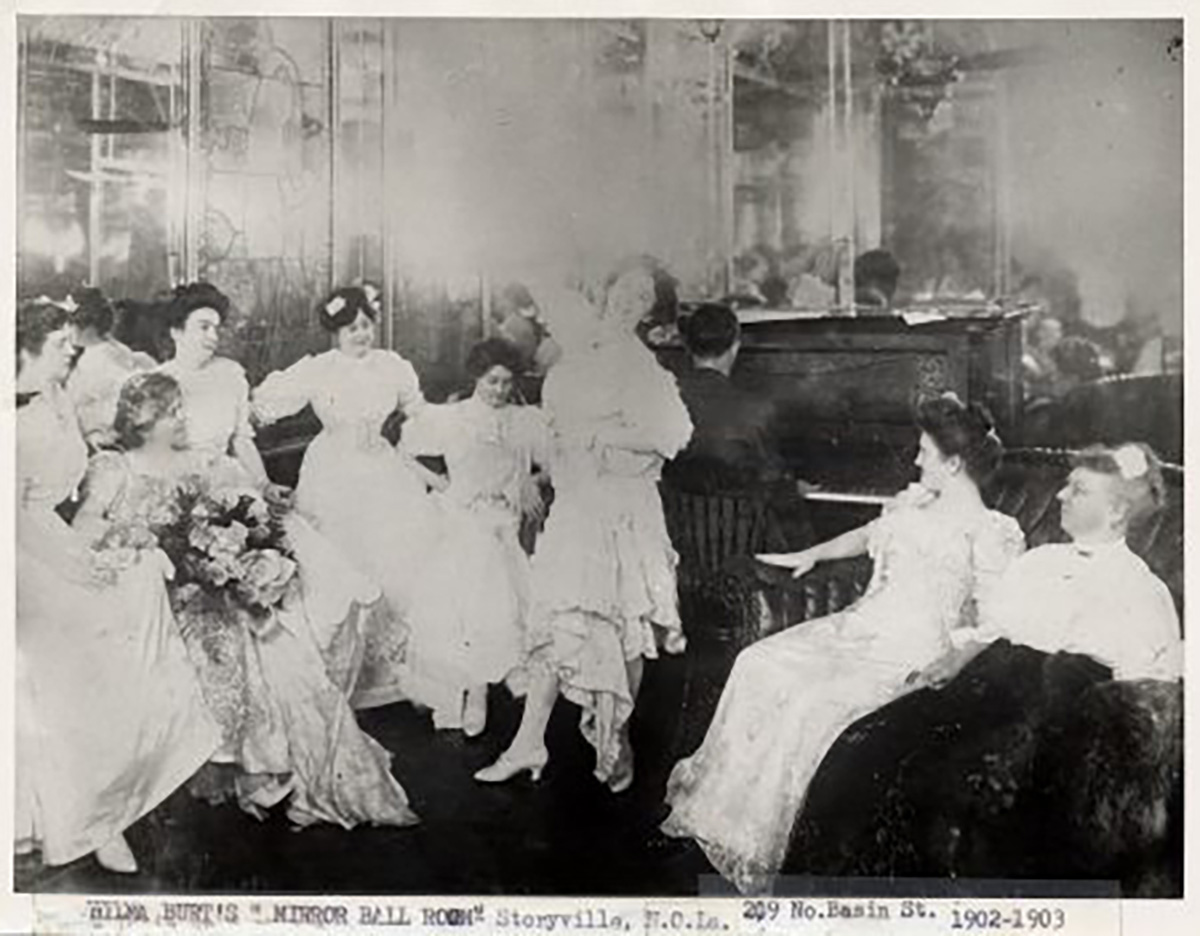
Photo courtesy of Louisiana State Museum Jazz Collection.
The piano was not only a musical instrument during this time. It was a piece of technology, a vehicle of distribution for cultural expression. Before radio, sheet music was the primary way to access these exciting new musical creations of the day at home. Many adults learned to sight read and play the piano with sheet music. More advanced players could make their livelihood playing in the community in a wide variety of settings. The sounds of an ensemble of instruments produced by concert bands and marches popularized by John Philip Sousa in the last half of the 19th century could be replicated with just ten fingers on one keyboard – one hand playing the tubas and trombones while the other hit notes to imitate the trumpets and clarinets. While the piano rose in society as the standard for musical enjoyment in smaller settings, night after night in the bustling public houses of Missouri and throughout the nation, dedicated musicians sought to develop their own unique playing and composing style...the search for a 'sound.'

Photo by Steve Hall, Heidrich Blessing.
Theoretically, the most definitive musical characteristic of ragtime is probably its syncopated quality. The etymology of the word syncopation can be traced back to the Proto-Indo-European root *kop-, meaning to beat, strike, smite. The word in a musical context refers to the way in which time, or musical beats, are divided. If something is highly syncopated, it will accent offbeats, or the beats that are typically weaker and unaccented. This creates an initial sense of disequilibrium for the listener, but ultimately achieves the effect of a strong sense of rhythm or groove. In fact, an old English musical term for syncopated notes was driving notes. In ragtime, not only were the melody and harmony interesting and depthful, but the rhythmic makeup of the compositions was highly developed and creative. This emphasis on syncopation was more scarcely exhibited in Western European music of the previous centuries, so much that Opera Magazine said of ragtime music in 1916: “Ragtime has carried the complexity of the rhythmic subdivision of the measure to a point never before reached in the history of music.”
This statement revealed a society with an incomplete understanding of the history of music. America and much of the rest of the Western world were unfamiliar with the musical traditions of Africa and the strong precedent of rhythmic sophistication in African musical culture. Because of this, ragtime was musically very different from what most Americans were used to hearing, thus its mass appeal. In essence, ragtime represented European Americans’ new acquaintance with African musical traditions. It fused the musical sensibilities of Africa and Europe and emerged as a musical form unlike any heard in the world.
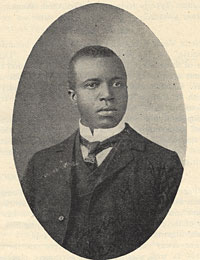
At the center of this musical development was a man often referred to as the king of ragtime: Scott Joplin. Joplin was born in Texarkana, Texas, and in 1885 at the age of 17 he established a homebase in St. Louis, Missouri. By 1900, St. Louis was a major U.S. manufacturing center with access to rail and water transportation. Industry thrived by day and money flowed by night through the places of amusement and entertainment. This meant plentiful work for traveling musicians, and Joplin established himself as an itinerant pianist in the region. In 1893 he traveled to the World’s Columbian Exposition in Chicago along with pianists from all over the Midwest who came to play in amusement houses throughout the city. Two of the main strips where they played: ‘The Midway’ on Chicago’s South Side and ‘The Levee,’ Chicago’s red-light district in the South Loop. The World’s Fair dazzled crowds tallying over 25 million with new electricity and ragtime, a new music that would soon after turn into a national craze.
While in Chicago, Joplin met many musicians who would have an impact on his life, including Otis Saunders. Joplin and Saunders became good friends and over the years, Saunders functioned as an advisor and manager for Joplin. In 1894, they both moved to Sedalia, Missouri, where Joplin had attended high school in the previous decade.
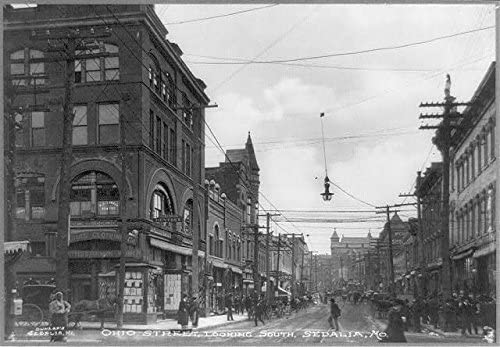
Sedalia was a bustling town, home to a large floating class of railroad workers and commercial travelers. It was known in the greater region for its nightlife and multitude of places to drink and make merry. With a population that grew to 15,000, Sedalia was also big enough to have a thriving social club for Black men, several Black newspapers, and the George R. Smith College for Negroes where anecdotes suggest Joplin attended music classes. It was here that Joplin began to evolve from the Texas pianist into the ambitious composer and innovator. He played in the Queen City Concert Band in Sedalia, whose repertoire included marches, waltzes, and other styles that were made for older European dances like the quadrille and the schottische. Much of the musical culture of the time revolved around this format, the concert band. As the ragtime style became more and more popular in the sporting houses, bands began to incorporate more syncopation and more African American folkloric songs into their repertoire. New dances like the cakewalk and the two-step began to take the place of the quadrille and the schottische. The music was evolving, and Joplin was beginning to put his ideas to paper.

In the summer of 1899, a publisher named John Stark heard Joplin play his composition Maple Leaf Rag at the Maple Leaf Club in Sedalia. They arranged a meeting for the next day and Stark purchased the composition for fifty dollars plus royalties to the composer. The piece was a huge success, and this began a relationship between Joplin and Stark that would be crucial to the further development and reach of ragtime. Over the next few decades, Joplin went on to publish over forty original ragtime pieces, as well as a ballet and two operas. Ragtime music had swept the nation, and in the following decades it stood as fertile ground for the development of jazz music.

Courtesy of www.scottjoplin.org/sedalias-ragtime-heritage.html.
Contemplating the history of ragtime gives us an added lens through which to celebrate our nation’s history and how we understand it today. Many ragtime compositions were written as collaborations between two composers, each writing different sections of a piece. This collaborative spirit resembles the birth of ragtime itself, which was born out of people from different backgrounds and histories working together and listening to one another. That spirit of collaboration and innovation is deeply ingrained in the American social fabric. In appreciating an art form so uniquely American, and so connected to Africa, we can reflect on the American cultural story more deeply and, alongside an awareness of injustices inextricable from this story, recognize the unique advancements of artistic expression that so define our nation.