Reflections on A Tale of Today: Nate Young and Mika Horibuchi
November 12, 2020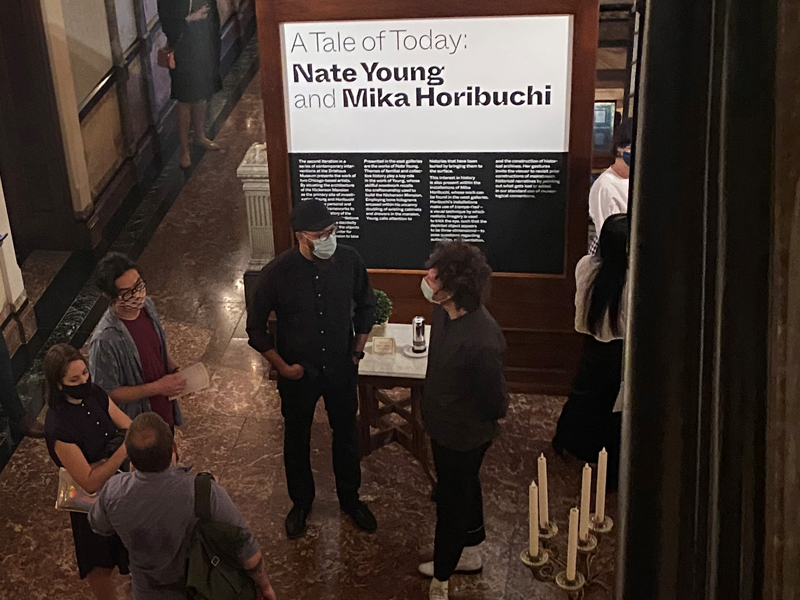
The Driehaus Museum's A Tale of Today: Emerging Artist Fellows reflect on opening of A Tale of Today: Nate Young and Mika Horibuchi at the end of September. The event also marked the launch of the 2020 Fellowship program.
- What part of opening was most impactful for you and that you’ll reflect on most often?
Alexandria Eregbu: The most compelling component of the A Tale of Today: Emerging Artist Fellowship for me has been the invitation to engage with the concept of the “house museum.” I responded strongly to how both artists, Nate Young and Mika Hirobuchi, used elements of their familial and ancestral heritage to respond to details of the museum’s architecture and Nickerson family’s overall collection of objects.
Devin T. Mays: I’d have to say seeing Nate Young and Mika Horibuchi’s name as I walked up main stairs of the mansion. It really set the tone. There was something about seeing their names prominently displayed in that particular typeface that energized me. I think for a brief moment that signage felt like a welcome, an invitation, to their home. Mika and Nate were welcoming us to their house.
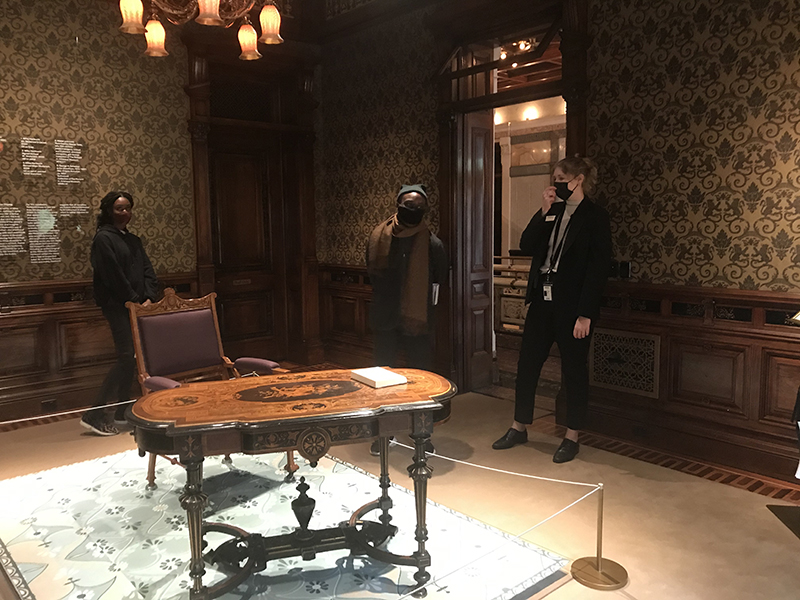
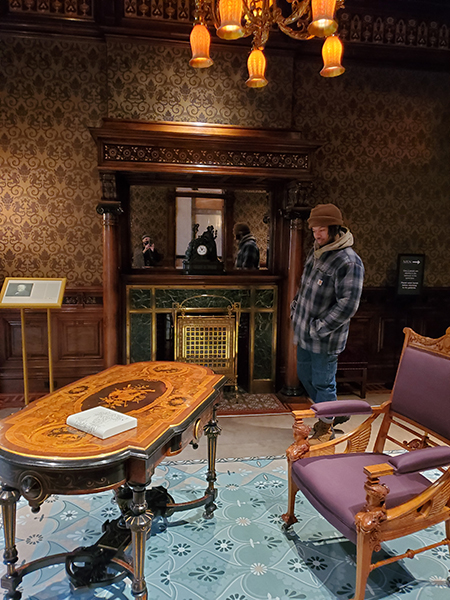
Maryam Taghavi: I attended A Tale of Today exhibition after the opening night. As the first-time visitor of the museum, this meant that my experience of the exhibition was concurrent to the experience of the museum itself. The objects in Nate Youngs and Mika Horibuchi’s exhibition are hyper aware of their surroundings, they mimic the space they inhabit and respond directly to the craft and materials of the historical artifacts, making the viewer look for what connects the present to the past.
My encounter with this relationship made me think: how does the present haunt the past, and how does the past haunt the present? What are the seams, edges and the shapes of this encounter? And how much of this material and formal mimicry are a work of fiction?
Unyimeabasi Udoh: I’ll get the obvious out of the way first: being back at a public event, all dressed up for an opening in the opulent setting of the Driehaus Museum, was fairly surreal. Seeing art and friends whom I hadn’t seen for months indoors and in person was both invigorating and (oddly, given the amount of time I’d spent doing both of these things before this April) strange. I think that the experience in its entirety, from the artwork to the conversation to the simple fact of being out in the world in such a fashion, will stay with me for some time yet.
- During the virtual panel discussion, what points were discussed that you felt were relevant to your practice?
AE: Personally, I have been thinking a lot about collections, the accumulation of information within art objects, and how the idea of “knowledge as art object” might travel or potentially circulate itself into public audiences, much like a library or in the case of this fellowship, a home of curiosities.
DTM: The part of the virtual discussion that felt most relevant to me were the points made concerning representation and presence. It’s something I often think about myself. These thoughts brought me to a series of questions that don’t necessarily need answering, but nonetheless grateful that they can be articulated in ways unknown to me before.
MT: Mediations on history, archiving and power resonated most with me. What is remembered, what is commemorated, what is archived, and whose stories gets to be retold subsequently lead to how our memory is constructed. Whose stories are told to the point of possessing the spirit of the present? How does one mine the stories that have no material presence or that exist in ephemeral forms like sound and movement? Thinking about the experience of an immigrant, I am particularly interested in how memory is skewed once removed from its place in addition to time.
UU: At two different points in the conversation, Nate Young said that he wanted his work for this exhibition to “kind of run away” from the viewer, and that he was attracted to the idea of “things that let us know that we don’t know.” Opacity is something that is central to my own work—especially as it exists in work that is otherwise clear, clean, and readable to the point of letting you know that there’s more that you can’t access. Both Nate’s and Mika’s work engages with this form of opacity, and I enjoyed hearing them discuss its place in their own practices. This and their discussion of subverting art-historical and -institutional narratives were particularly relevant to me.
- Who did you meet or connect with during opening that you were most excited about?
AE: Overall, I look forward to learning more about the Driehaus Museum history and further exploring intersections I am observing in the development of my own practice. The Tale of Today Exhibition: Nate Young & Mika Horibuchi has been a great source of inspiration.
DTM: I was really excited to meet my A Tale of Today fellow member Unyimeabasi Nkereuwem Udoh. Due to the pandemic we were unable to meet in person and the opening was our first opportunity to connect. At dinner we had the opportunity to share space and develop community. I had a great time. Uno is amazing.
MT: I sadly missed the opening so I missed the opportunity to meet the invited guests.
UU: Everyone! In all honesty, it was exciting to reconnect with Kekeli; to meet the rest of the Driehaus’ team and one of my fellow Fellows, Devin, in person for the first time; to run into friends and acquaintances among the other guests; and to meet Nate and Mika. I’ve admired Nate’s work since I moved to Chicago, and so I especially appreciated the opportunity to have an extended conversation with him, Kekeli, and Devin.
- What was your favorite part of the exhibition in general?
AE: I especially gravitated to Nate Young’s work and his body of paintings from his great-grandfather’s letters. I think a lot about legibility and methodologies the artist might use to drive the reader or audience’s attention to things unseen. In Nate’s case, he was able to manipulate the way in which his application of the lettered text wove itself in and out of the background and foreground of his grayscale paintings. He also was able to distill some elements of his great-grandfather’s story into symbolic objects that worked their way into the furniture he created, inspired by the original furnishing materials used in the Driehaus Museum.
DTM: My favorite part was seeing how the participating artists gave themselves permission to make themselves at home. Something that I imagine is not easy at all to do. Especially in a place, in a home, that has so much tradition and legacy. Finding a way to find yourself as an active participant in such a monument of history is encouraging and empowering. I hope to give myself the same permissions.
MT: I was struck by the piece that appeared to be black on black drawing, that revealed some words once the body was repositioned in relationship to the artwork--mostly lowering the entire body to see the drawing from the bottom edge of the work up. These words formed segments from a suicide letter that was handwritten by the artists’ grandfather who migrated to the north during the Great Migration. I was immediately struck by the eerie presence of that letter, in fragments, out of context and far removed from its provenance. Unlike the content of the letter and its author, the form and craft of the object mimic those of the house museum. This resemblance of form, amplifies the tension in these incongruous narratives that belong to concurrent periods.
UU: I have a hard time picking favorites. But if I must choose one thing, I would say that it was the feeling of potential brought on by interacting with great art and great people on such a triumphant occasion.