The Nickerson Series: George Washington Maher
July 13, 2020
The Nickerson Series was initially established as a lecture series that aimed to situate the Driehaus Museum and the historic Nickerson Mansion in the wider context of America’s Gilded Age culture and the design philosophies of the period. That intention is extended now to this blog series which brings you the story of the Nickerson Mansion as told through the eyes of the individuals who played the most significant roles in its creation and design, reflecting on the legacies they have left us.
Originally published on June 21, 2014
As Interior Designers of the Nickerson Mansion: George W. Maher
Visitors often cite the Maher Gallery as their favorite space in the Museum. It is the only room in the mansion that was altered in 1901 when the second owner Lucius George Fisher, Jr. hired George Washington Maher to create his trophy gallery. Maher's addition included the room's impressive stained-glass dome and lacquered cherry bookcases for Fisher's rare book collection. A massive wood-burning fireplace was installed and decorated with an Art Nouveau glass mosaic mantle facing of iridescent, opalescent and metallic luster glass.
Perhaps Fisher wanted to put his own stamp on the Nickerson’s distinctive décor? Or did he just want a grand showcase for his collection of rare books and hunting memorabilia? Whatever his reasons, he hired one of the great Prairie School architects of the day, George Washington Maher.
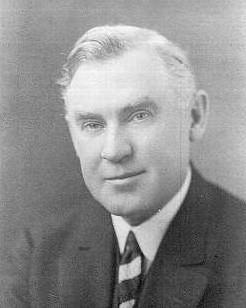 George W. Maher was born in Mill Creek, West Virginia in 1864. But by the age of thirteen he was living in Chicago and apprenticed to the architectural firm of Bauer and Hill. After the wide-spread destruction caused by the Great Fire of 1871, Chicago had become a center for innovative building design and attracted many emerging and established architects and craftspeople from around the world. After a stint with Joseph Silsbee, where Maher worked as a draughtsman alongside Frank Lloyd Wright, he opened his own firm in 1888. Influenced by the styles of H. H. Richardson and Louis Sullivan, Maher’s houses reflect the “form follows function” dictum associated with Sullivan’s work. While fellow architect Wright would follow the elaborate ornamentation of Sullivan’s cursive elements, Maher would eventually lean towards the Arts and Crafts movement in the houses he designed.
Beginning in 1893 with his own home in the northern suburb of Kenilworth, Maher went on to design forty distinctive houses there, as well as several homes in Chicago’s historic Hutchinson Street District in Uptown. At the same time, he became allied with the developer of the Edgewater community on Chicago’s lakefront, producing a series of homes that still stand today on Sheridan Road.

The most influential commission Maher would receive was from investment banker and philanthropist John Farson. The house, designed in 1897 and now known as Pleasant Home, (pictured above) broke with the traditional Queen Anne and colonial revival styles of most homes in Oak Park, IL. The simplified forms, broad front porch, smooth surfaces of Roman bricks and stone, and the use of repetitive decorative motifs to unify the interior and exterior decoration and furnishings (what Maher called Motif-Rhythm Theory) established the tenets of Prairies School design, and its success was copied time and again by other architects of the period. (www.pleasanthome.org)
Much like the Nickerson Mansion, Pleasant Home is a showcase of 19th-century craftsmanship and artistry, with rich custom woodwork throughout, extraordinary art glass windows, massive fireplaces, intricate woodcarvings, and tile work.
In 1900, the Nickerson Mansion was sold to its second occupants, the Fisher family. Lucius George Fisher, a real estate mogul and president of the Union Bag and Paper Company, commissioned one of Chicago’s first skyscrapers, the Fisher Building, designed by Daniel Burnham & Co. and completed in 1896.
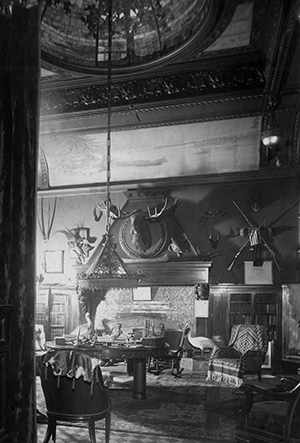 In 1901, Fisher commissioned Maher to redesign what had been the Nickerson’s purpose-built art gallery. Originally, the space had a rather small corner fireplace and plain glass sky-lights suitable for showcasing their painting and sculpture collection. In Maher’s renovation, the room was transformed into a den and featured Fisher’s collection of historical weapons and animal trophies.
Architect Robert Seyfarth (1878-1950) collaborated with Maher and was responsible for the lion-motif carvings throughout as well as the center table, cabinetry, and mantelpiece. New features in the room also included tall lacquered cherry bookcases for Fisher‘s rare book collection and the monumental, centrally located fireplace with iridescent tiles arranged in sinuous, curving lines that reflect a modern Art Nouveau design. The crowning achievement of the Fisher renovation was the installation of a striking stained-glass dome with a lay light surround, which the Museum believes to also have been completed by Giannini & Hilgart, however, there are no markings and no researched publication which confirms this. The dome features four trees, the trunks of which arch toward the oculus, while their leaves, rendered in autumnal colored drapery glass, form a canopy against a turquoise sky.
Over the years, Maher designed numerous houses for clients ranging from middle class businessmen to wealthy society figures. He was commissioned for a few non-residential buildings as well, such as the Patten Gymnasium on Northwestern University’s campus, opened in 1910. Throughout his career, Maher was involved in organizations seeking to improve the architecture profession—in addition to the Chicago Architectural Club, he was active in the American Institute of Architects, serving as state chapter president in 1918.
Maher’s son Philip, born in 1894, joined his father’s office after World War l and the firm became known as “George W. Maher & Son.” In the early 1920s, Maher explored his interest in town planning, and designs were prepared for Glencoe, Kenilworth, Hinsdale and other communities including Gary, Indiana.
Maher suffered from poor health in the early part of the 1920s. He was hospitalized for a period of time for depression from which he never fully recovered. Unable to fully regain his health, George W. Maher died by suicide at the age of 61 in late 1926.
Resources: http://www.georgemaher.com
http://www.pleasanthome.org

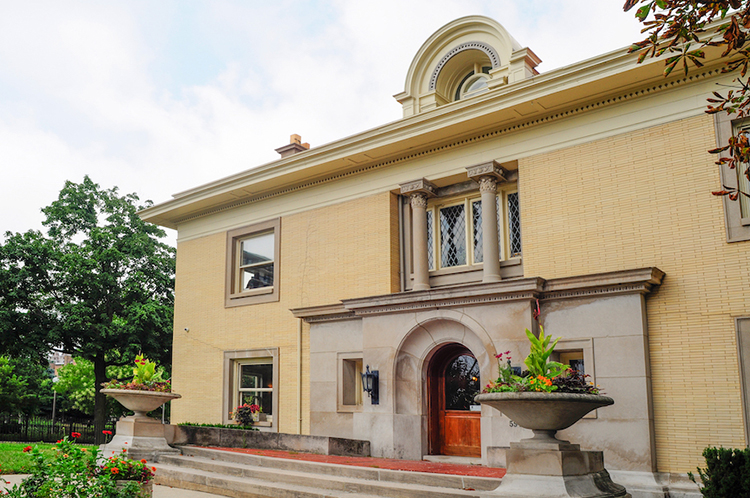
Images top to bottom: Detail of Maher Gallery dome and fire surround by Steve Hall of Hendrich Blessing, 2008. Portrait of Maher and image of Pleasant Home, accessed at Wikimedia Commons. Historical photograph of the Nickerson Mansion during the Fisher Period, c. 1901. Image of the Colvin House in Chicago, IL, courtesty of www.colvinhouseevents.com