The Nickerson Series: John Gardner Low
August 26, 2020
The Nickerson Series was initially established as a lecture series that aimed to situate the Driehaus Museum and the historic Nickerson Mansion in the wider context of America’s Gilded Age culture and the design philosophies of the period. That intention is extended now to this blog series which brings you the story of the Nickerson Mansion as told through the eyes of the individuals who played the most significant roles in its creation and design, reflecting on the legacies they have left us.
Originally published on July 9, 2012
As Featured Designer: John Gardner Low
John Gardner Low was a ceramics artist of about 41 when he approached the crowded exhibitions in Philadelphia at the 1876 Centennial Exposition. He was a Massachusetts man and had traveled far, like the millions of others, to see the first U.S. World's Fair.
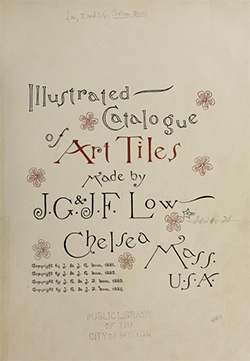 There was no shortage of sights to catch the eye—from Alexander Graham Bell’s telephone to the Statue of Liberty’s just-constructed right arm. What would most inspire Low, who had studied in Paris and worked for the Chelsea Keramic Art Company, were the ceramics on display. American Art Journal would soon after note that the “collection of pottery and porcelain at the International Exhibition surpasses, for educational purposes, anything that can be seen of modern manufacture in any museum” in the U.S. Particularly, it was the highly-decorative European tiles that caught his eye—not intended just for a utilitarian, easy-to-wipe-down fireplace hearth, these pieces were intricately artistic.
Low went home to Chelsea and, with his father John Low, established J. & J. G. Low Art Tile Works the very next year. The tiles they produced were highly decorative, with patterns developed from bits of real nature, such as grasses, clover leaves, and buttercups, impressed onto the clay. When the Lows employed the English artist Arthur Osborne as the firm’s chief designer in 1879, he created bucolic landscapes, mythical scenes, and portraits in the glazed and fired clay, some of which were intended to be hung on the wall as one might a painting.
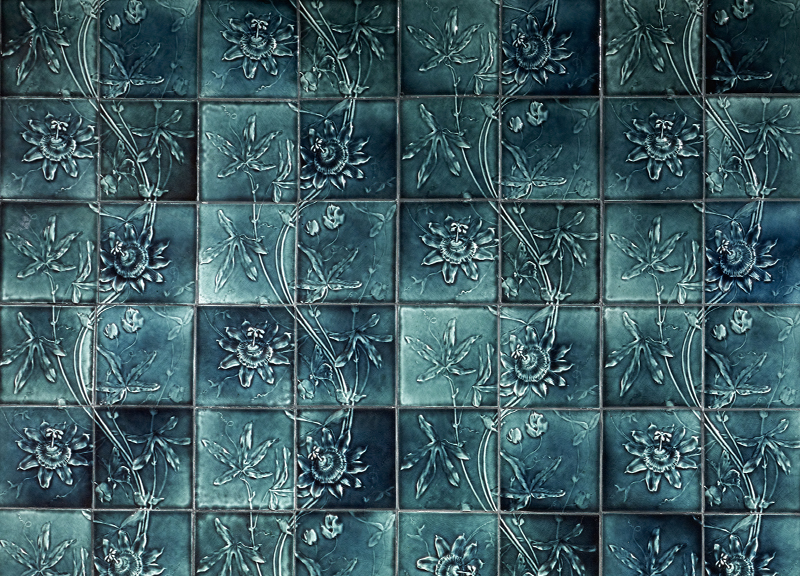
When the Nickersons commissioned their Chicago mansion, Low Art tiles were featured prominently throughout the interior decoration. Turquoise tiles in a repeating passionflower vine pattern cover the upper half of the walls in the Reception Room, the first room any guest would encounter before being admitted to the house. A more abstract design in a cool, light blue appears in the Moorish tiles on the Smoking Room walls; the same blue was used in the hearth of Mrs. Nickerson’s Bedroom.
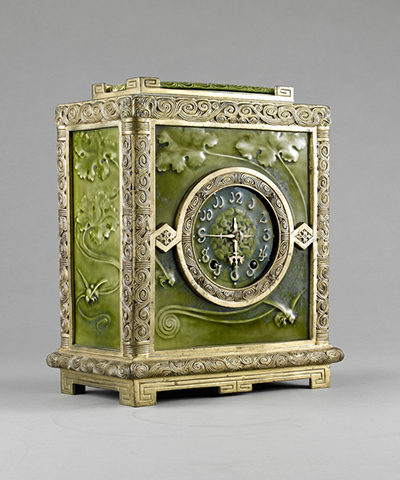 On a third-floor gallery’s fireplace mantel sits a green glazed-tile and gilt bronze clock by J. & J. G. Low from the Museum’s permanent collection. This clock model, titled Albatross, features an asymmetrical Japanesque insect-and-leaf design and was offered in different glazes, such as olive green, deep blue, and mustard yellow. The art tiles appear in the house’s en suite bathrooms, too. Mr. Nickerson’s bathroom—the Museum’s men’s restroom today—is of particular note for the gorgeous green Low Art tile covering the walls and culminating in a dragon frieze near the limestone ceiling.
The Low Art Tile Company thrived, mainly on high-end clients like the Nickersons—Gilded Age millionaires for whom it was fashionable to display the jewel-toned, uniquely American art tiles—until shortly after Low’s death in 1907. It is still considered one of America’s greatest 19th and 20th-century tile companies.
Sources: The Philadelphia Museum of Art Rosenberg, Chaim M. Goods for Sale: Products And Advertising in the Massachusetts Industrial Age, p. 82 The Low Art Tile book collection at Virginia Commonwealth University Libraries
Image credits: Top image, Smoking Room Wall Detail, Photograph by John Faier, 2013. Image of Low Art Tile catalog courtesy of The Boston Public Library and Archive.org. Reception Room Wall Detail, Photograph by John Faier, 2013. Image of Low Art Clock, Photograph by John Faier, 2013.